
The 3-Step Framework Every Parent Needs to Build Truly Resilient Kids
Check out the podcast on…



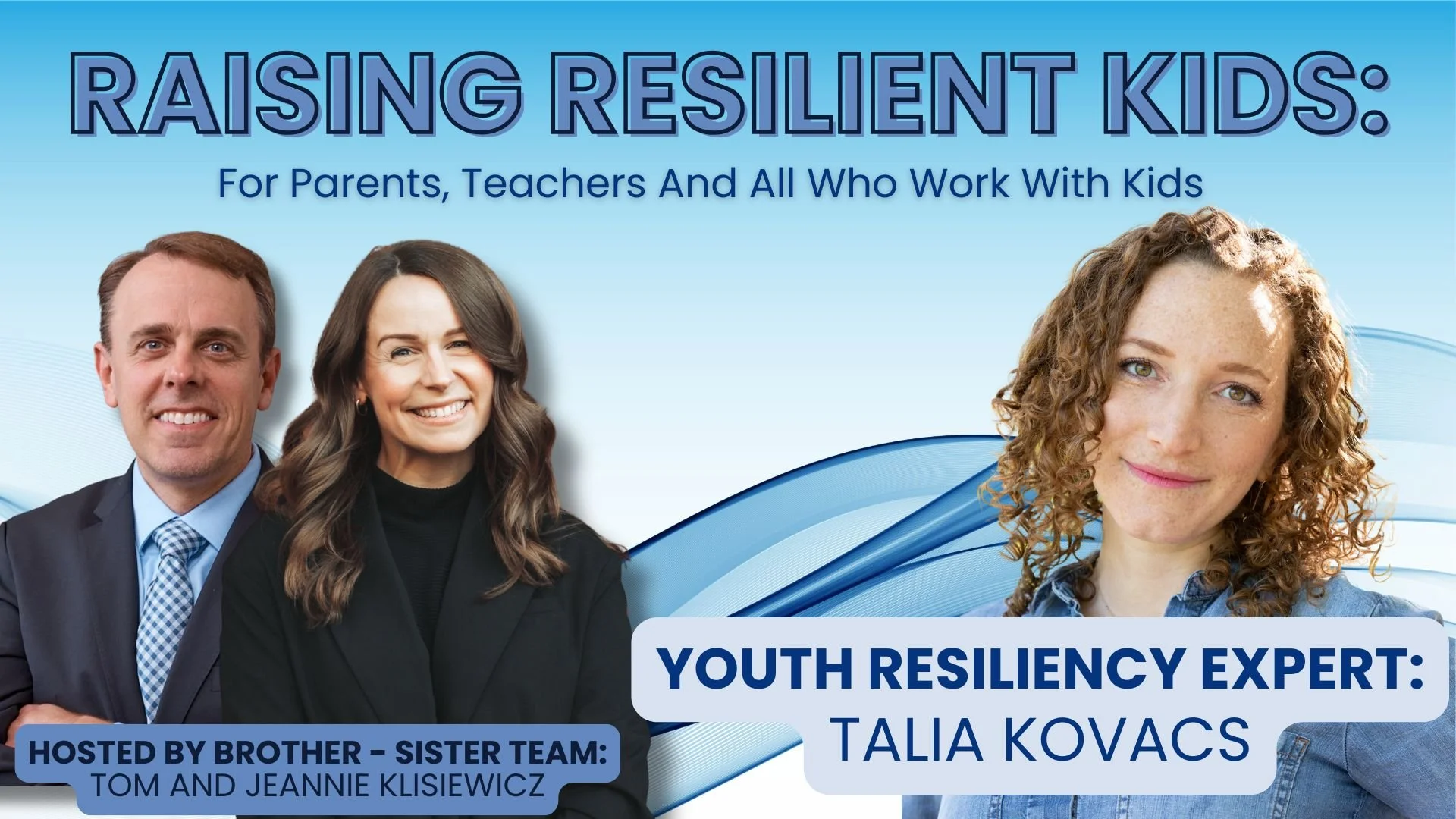
In this episode of the Raising Resilient Kids Podcast, Tom and Jeannie sit down with Resilience Expert and educator Talia Kovacs, founder of Calm Connected. Talia brings a rare perspective to the resilience conversation — one grounded in 17+ years of classroom teaching, literacy coaching across hundreds of schools, and teaching Raising Resilient Kids, her own parent empowerment program.
Talia opens with a game-changing mindset shift: parents need to think less like engineers (expecting specific inputs to produce specific outputs) and more like gardeners — observing, adjusting, and trusting that there is TIME to make positive changes. This reframe alone reduces parental anxiety and creates a calmer household climate.
From there, Talia walks through her powerful three-step resilience framework: starting with yourself (because resilience is modeled, not taught), creating the right conditions at home through sustainable systems and structures, and finally building your child's inner capacity. Critically, she explains why so many parents want to skip straight to step three — and why that always backfires.
You'll also discover why resilience is built through connection and community (not grit), and the one simple thing — delighting in your children — that you can start doing this week to shift the entire dynamic at home.
In This Episode You'll Learn:
Why resilience is modeled, not taught — and what that means for YOU as a parent
Talia's 3-step resilience framework: Start with yourself → Create conditions → Build capacity
How to use your child's unique strengths as the foundation for resilience
Why kids need time to 'fail privately' — and why this is disappearing from childhood
The research truth about resilience: it's built in community, not by pushing harder
One action you can take THIS WEEK to start transforming your home environment
About Talia Kovacs
Talia Kovacs is the founder of Calm Connected and creator of the Raising Resilient Kids class. A former classroom teacher and graduate-level education professor, Talia spent years as the CEO of Lit Life, an international literacy consulting firm, coaching teachers across hundreds of schools on social-emotional based literacy. Her work has been featured in Forbes, Newsweek, the Today Show, and Scholastic. Talia serves on the board of directors for Lit Life and is dedicated to equipping parents with tools to foster deep inner resilience in their kids, creating calm, connected families where children truly thrive.
Connect with Talia
Website: https://taliakovacs.com/
Free Gift — 5 Steps to Use Your Kids' Strengths to Build Resilience: taliakovacs.com/gift
Thank you
Thank you for listening to the Raising Resilient Kids Podcast! We are siblings on a mission to help kids become their strongest selves. Each episode, we share proven strategies with parents, teachers, and all who work with youth and teens to build resilient, confident kids who can tackle life's challenges and thrive.
For more information on the podcast, or if you have a question you would like answered by one of our expert guests, please visit us at –
https://www.smarthwp.com/raisingresilientkidspodcast.
A Special Thanks to our Sponsors
Episode Transcript
Jeannie: Are you raising a child who melts down over the small stuff and you're not sure what to do? Resilience Expert, Talia Kovacs, says the answer isn't pushing your kids harder- it's about the systems you build at home. In this episode, Talia shares her powerful three step resilience framework, why she wants parents to think like gardeners instead of engineers and the one simple thing you can do this week to start building resilience in your kids, I'm Jeannie.
Tom: And I'm Tom. We are siblings on a mission to help kids become their strongest selves. Each episode we share proven strategies with parents, teachers, and all who work with youth and teens to build resilient, confident kids who can tackle life's challenges and thrive. Welcome to the Raising Resilient Kids podcast.
Jeannie: All right, Tommy. So I am very excited. First of all, I'm excited that we're in the same room. Yay. Right now. That's not the way we normally do things, and I'm really excited for our guest. Talia Kovac actually reached out to us and when we read about her and all the amazing things that she's doing, it completely lined up with what we do here.
Talia Kovacs is the [00:01:00] founder of Calm Connected, giving parents the tools to foster resilience in themselves and in their kids. Her work on creating calm, connected families and social emotional learning has been featured in Forbes, Newsweek, Today, love The Today Show, Scholastic and many other news outlets.
Talia serves on the board of directors for Lit Life. She has previously served as a classroom teacher, a graduate level education professor, and as the CEO of Lit Life, an international literacy consulting firm. Talia's greatest mission is equipping parents with tools to foster a deep well of inner resilience in their kids, so that the whole family can live in calm, connected households where children thrive.
All the things that we're working for Talia, thank you so much for joining us from New York!
Talia Kovacs: Hi. Yes. I'm so happy to be with you guys.
Jeannie: So let's kind of kick it off. So, what are some of the big shifts that parents can make to develop resilience? You know, overall at home, both in themselves and in their kids?
Talia Kovacs: I [00:02:00] think that, um, as parents ourselves, we are really inundated with information right now about, if you just say this then, your kid will all of a sudden become this, this independent and capable, um, kid. And so I think that the big shift that we need to make almost as like a generation of parents right now, especially parents of elementary schoolers, is that we are actually gardeners, not engineers.
Um, a a lot of the, a lot of the, the things that we read and, and you know, what I'm scrolling through on my reels is like, say this and then things will be fixed. And that's a very engineer mentality. You know, A plus B equals C. If you have the right inputs, you can expect these same outputs, but resilience really isn't like that.
Resilience is more like gardening where you watch, you see if a plant is growing and you actually have time to shift it, right? Like it's not this kind of big emergency.
The big shift [00:03:00] I think for us is as we as parents can sit back and look at our kids and you know, if something is going in the wrong direction, right like if a plant is growing in the wrong direction, you can re-pot it and move it to a sunnier spot or a shadier spot. You have time. And that mentality will reduce the stress at home for parents, and it therefore reduces the stress, um, for kids. So what I talk a lot about in my similarly named Raising Resilient Kids Class is that it's not about the right thing to say.
It's about the systems you have at home.
Jeannie: I do love that idea of like, you have time. I think like as parents or anything, you feel like, I've gotta do it, I've gotta do it now. So I have to say this, and this has, it's like, Hey, this. We can, you can take your time, like you said, make changes.
Tom: Yeah. I'd never heard that, that gardener versus engineer, that is a wonderful, wonderful analogy.
Mm-hmm. That, that is, yeah. I really love that. I'm curious, how did, how did you [00:04:00] start this, you know, to get into this line of work and start, you know, opening your own business around raising resilient kids?
Talia Kovacs: I was a classroom teacher for a long time and then, um, and I've heard some of the many wonderful teachers on your podcast. I spent many years running around the country as a literacy coach, so I went into most schools, like many, many, many schools around the country, hundreds of schools teaching teachers to teach social, emotional based literacy.
So I was in classrooms doing demonstration lessons, doing teacher learning. I then became the CEO of that company and I started to travel a little bit less. Um, but what I learned in my travels was that pre COVID, this was not like a COVID issue, but that there, our kids' ability to bounce back from, things that go wrong for them has been decreasing drastically, even just in the more than 17 years that I've been teaching.
And so I really tried to impact this, you know, through [00:05:00] schools, working with superintendents and principals to really shift culture in schools. And I think that that is a great way to go. But as parents, we're with our kids for, you know, 18 plus plus plus years for the rest of their lives, if we're lucky, you know, and not just, you know, eight hours a day for a year.
And there's just so many shifts that I've started to notice knowing more parents and becoming a parent myself, and being around parents that, um, that classroom teachers know that I think, um, is missing from the conversation with parents. I see a lot of conversations around resilience come from therapists and there's so much room for therapy for kids. But there's almost like a higher level of a systems based approach that teachers have that teachers know that it's really about the structures that I think gets lost in the conversation sometimes with parents. So that's, that's really why I started this work, was to bring what I know from my time in the classroom and from my time as a teacher of teachers, um, to parent [00:06:00] communities.
Jeannie: Can you walk us through the three key systems of the resilience framework that you teach in these classes and workshops?
Talia Kovacs: Yeah. So, um, I have a framework that I teach the, the resilience framework. Um, and these are three steps that you will recognize as the steps that you need to actually learn to do anything. And so, um, and so the first step, and there's a bunch of, um, substeps, but the first step is we start with ourselves.
Resilience is earned and learned, but it actually can't be taught. Resilience is modeled. And so as parents, we need to really tap into our own wells of resilience, know, understand that what we're doing is impacting our kids whether we want it to or not. And so we have to change. If we want to see a change in our kids, we actually have to change how we see our kids.
For our kids, it's very much I am as I am seen, and so we, what I work with parents on is shifting their own, um, weather creation systems. We as [00:07:00] parents create the climate in our household, and so we are working with parents on creating a warmer friendlier climate first before we ask our kids to do anything.
And then the next step is to create the right conditions at home. And this is what I mean by a systems framework as opposed to, you know, say this and then that. Which is really about, uh, do your kids have time to play independently? Do your kids have, um, time to be responsible for something besides themselves in the household?
And that kind of goes beyond chores, but really around, um your trickiest kid at home knows that they have an impact on the house, right? They know that they are the reason why everybody was arguing during dinner, or that they didn't get out to their grandparents' house that day, or that they had to leave early from the party.
They know what their role is in the house, and so if we're really looking to build resilience to create the conditions for that kid to feel like a positive contributor at home too, and we can do that through a strength based approach. [00:08:00]
And then finally the third step is building our kids' capacity. So after we've started with ourselves, after we've created the conditions for resilience, then we look at how do I help my kid develop their inner resilience?
And I think that that's actually what a lot of us wanna skip to, right? How do I build my kids' capacity? Um, but we really need those first two steps in order to lay the foundation for, for building capacity to be successful and and sustainable.
Tom: I never thought about that, but that is so important. Those first those first two key steps. And the trickiest kid, every parent got a trickiest kid.
Jeannie: It was Tom.
Talia Kovacs: I was gonna say between the two of you.
Jeannie: In reality, in reality, it was our middle brother.
Tom: Talia, you mentioned a, a therapists a moment ago, and, and that's some, a question I get from parents a lot is, is, you know my kid's struggling. Can I take these techniques and will they help? Or, you know, when do I need to bring in [00:09:00] professional help versus me stepping in and, and, and helping out instead?
Talia Kovacs: Yeah, I work with a lot. I'm, I'm referred by a lot of child therapists and I refer to a lot of child therapists and what they always tell me and, and what I see to be true is that there's so much room for your kid to develop a great relationship with a therapist and see things shift.
But that's really, if we were just talking about those three steps, start with yourself, create the conditions and build capacity that's really under building capacity. So we wanna think about, um, as parents, have we done what we can? If you picture your kid in like a dollhouse, right? Like, did we make sure that the roof isn't leaky and that there's a warm carpet underfoot and that it smells nice and that there's not a draft coming in through the window, right?
Are we doing all we can to create the right surroundings so that our kid can thrive? There's a lot of parents who come to the raising resilient kids class thinking, I'll do this, and then I'll put my kid in therapy, and, many, many, many [00:10:00] times after the class, after creating the structures at home, they start to see really positive shifts in their kids. And they no longer feel like their kid needs therapy.
That's not always true. Sometimes it's, I've done everything that I can and there are positive shifts, but I still feel like my kid would benefit from a warm adult relationship with an outside adult. And that's when you put your kid in therapy, you know, and so and so, I don't think that there's one right answer, but I do think that, as parents, we oh, it's not that we want to outsource, right? But we, but we wanna really think about, am I really creating the structures at home? Because one hour a week is not what's going to shift things if the structures at home aren't there.
Tom: Can you talk maybe just a little bit about the, you know, the creating the culture at home? Maybe one or two tips that, that you think would help parents that they can implement in their home.
Talia Kovacs: Yeah. Um, I, I operate out of a strengths-based approach, and that's, and that's really where my, my training and education comes [00:11:00] from, um, is a strength-based approach to learning. And so what I do with folks first is figure out what are your kids' strengths? Because we want to actually start with using a kid's strengths to build resilience.
So, um, there's a term in education called the zone of proximal development. And what that means is what do you know? So that then I can help you build on what you need to know next. Do you know how to add numbers to together? Because I can't teach you multiplication unless you know how to add, right? So for a kid whose strengths are, you know, empathy and curiosity.
They're going to build resilience really differently than a kid whose strengths are leadership and social awareness, you know? So we really wanna think about a kid's strengths of character. I actually have a gift that I can give you guys the link to, but it's five steps to using your kids' strengths to build resilience.
That's really the first shift is, um, is that resilience is actually one of the ways you can build resilience is by going through really hard, you know, grueling [00:12:00] things as a kid, that's one way you can build resilience. It's almost like the quick way, right? And then, um, but not all of our kids are going through hard stuff and thank God, you know, so, so the, so the other way that we build resilience is by giving our kids the opportunity to practice their independence at home and the way that they're going to be able to practice independence varies depending on what their strengths of character are and where you see their starting place from. A lot of us can list like the top 10 things that we need our kids to work on. But if we are asked to list the top 10 things that are going really well, it might take us a little longer. So if we start with what's going well, it actually gives us a place to build.
Jeannie: What is one misconception about building resilience in kids that you find yourself, you know, correcting the most often?
Talia Kovacs: As, as Americans here, um, and, and I think just in the western world in general, we are really like, uh, pull yourself by your bootstraps nation and, and so, um, and I think a lot of us think of resilience as like, you just have to grit your teeth and push through it. And there's a lot of studies that show that resilience is actually built in community.
Actually the term pull yourself up by your bootstraps was, it was coined in the mid 1800s as something that is physically impossible to do. It used to mean something that is so ridiculous that of course you would never consider doing it because picture it like you can't pull yourself up by your bootstraps, actually.
So, so somehow it's gotten all turned around, but, but really, resilience is not built by pushing. Resilience is actually built by knowing that you have a soft place to land. And all of the studies on resilience really show that it starts with either taking good care of yourself or having the community take good care of you.
And that is where you start to build your foundation of resilience. So I would say that the big misconception is that, um, I need to, you know, I need to push [00:14:00] my kid harder. Like they're, they're too soft, they're having too many meltdowns. They're breaking down over such small things, and I need to like show them how to not break down.
But actually it's about what you do and outside of all those moments of meltdowns that will impact the meltdowns in the long run. But it's really about does your kid have, does your kid know what their strengths are? Does your kid feel like they have a positive role within the family dynamic? Does your kid have time for independence? Meaning, do they have time to fail privately without an adult watching? Um, and those are the things that build resilience, not, you know, kind of pushing and gritting and moving through in a, in a hard way.
Tom: In, in your programs, um, do, do you, is it just the parents in them? Do you have the kids in them too? I'm curious how your programs are structured.
Talia Kovacs: That's a great question. Yeah. I used to do parents and kids and I found that, um, sometimes when I would see kids, parents would feel like, "okay, you've got that, like you've got, you're working with the kid and like, I will do my [00:15:00] things." But, um, but now I am just focused on parents and the, I think it's actually like really an empowerment issue.
Um, as, as parents maybe, you know, 200 years ago, we would've just seen the people in our community parenting and we would've seen them do it well and poorly 'cause we would've seen them on their good days and bad days. But now we're seeing only the highlight reels of everybody's parenting. And there's almost like a disempowerment that comes from, like, everybody else has got this under control except for me.
Uh, and so, and so I, I only work with parents now, um, and they work with their kids and I guide them through working with their kids. But it really is an empowerment thing. It's, it's about, no, you have what your kid needs and, and I'll give you the tools to make it happen in your home. And that's how I know that it's sustainable and it's not just like, you know, four months with your kid and then things are good for another four months and then they start to fall apart again.
You know? But it's really giving parents the tools that they're gonna use in different ways as kids [00:16:00] grow, but that they're gonna use for the rest of the time that their kids are home.
Tom: Looking at your website, I saw there were a ton of great testimonials from parents about, about how much they, they love your program and how much it helped, you know, them build the resilience of themselves, their kids, their, their family. Can you maybe just give us an example of a family that, you know that you worked with in the past that what were the, the issues they were dealing with, and how did your programs help 'em kind of make it through those issues?
Talia Kovacs: Yeah, I could tell you about, um, and any family that I talk about or that's whose testimonials on my website, I have their permission to, to talk about it. And so, um, and so I can tell you about Shannon and Paul who came to me with two girls in lower elementary school, um, and, and they were, and they were having some trouble with their oldest.
They knew that she needed more attention. They felt bad that their younger daughter wasn't getting the attention that she deserved because they were so focused on what was going on, with their older daughter and, um, and they were at a point where they do I put her in therapy? Like it's, it's [00:17:00] feeling really bad at home, but I don't want her to kind of get a label for herself.
That's what kind of, that's what caused them to come, was there were all these big meltdowns. They didn't quite know what to do. The school was like, maybe she should go to therapy, but they kind of felt like there's gotta be some middle ground, something that we could do before, before we go that route.
And so in the class, what they say, and, and you could see their video on my website, but what they talked about was that. First of all, this has never, this has never been my intention, but every time a couple comes into my class, they say at the end that they are communicating better about their kids.
They're operating from the same, yeah. It's like, not why I started. Right. But, but it is, it is. You know, they're, they have the same tool book and honestly, usually there's one parent that there's a parent that's listening to this podcast and then there's the parent and then they're sending it to their partner,
Tom: Yeah. Yeah, yeah.
Talia Kovacs: and, and so it's nice to have both of them as the learners sitting at the same side of the desk with somebody else on the other side asking, did you do your homework? And let me, you know, correct you on this [00:18:00] response or let me push you a little bit further. And for them to both be at the same level of learning, that's actually really powerful in a parent dynamic instead of kind of one, always being the, the one who send reads the books and the one who sends the articles and sends the podcasts and, um, and so and so there was that element that they talk about. But, but also really they noticed that in shift in understanding better about where their daughter was coming from and in operating from a strengths based approach because just like many, many, many parents, they could tell me everything that they wanted to fix and, um, focusing on what was going well was was harder and almost felt like besides the point, you know, like, it's going well, so why would I need to tell you about it?
Um, and so and so by making these kind of sustainable shifts, the way that I teach the Raising Resilient Kids class, it is a standalone program, but a couple of times a year I do it where I meet with folks, you know, every few weeks and, and we really dive deep into their family and their kids and, um and they started to see fewer meltdowns. They started, their [00:19:00] daughter, started to see herself as a positive influence in the family as opposed to all of the things that she wasn't doing well. And so it's not like, oh, everything was perfect by the end. I, I don't think that that's realistic. We're dealing with like real people in real families.
But they noticed fewer meltdowns. They noticed that they were able to spend time with both of their daughters, there was less sibling. I do a lot of work around, you know, navigating sibling dynamics and kind of getting rid of that fairness idea, um, and, and getting rid of some of that jealousy and competition.
And so, um, their daughters were getting along better. There were less meltdowns at home and they were operating. Right.
Tom: Maybe you can help Jeannine and I. Because I can definitely relate to the, the poor girl who, who wasn't getting a lot of attention because the other one took all the attention.
Talia Kovacs: Yes. It's real. It's real. I mean, we all, we all have that sibling,
Jeannie: it is so inspiring to hear what happens inside and then this testimonials where can people that are listening right now connect with you and learn more about your programs?
Talia Kovacs: [00:20:00] Yeah. Um, uh, you can come to my website, it's taliakovacs.com. I'm happy to give a gift, um, which is Five Steps to Use Your Kids' Strengths to build resilience. It's really important when you're building resilience to start with what is working. That is actually the only way that anybody ever learns is starting with what they already know.
Tom: Oh, cool. Thank you so much. That's great. Great. Thank you. This was, this was wonderful. You know, as kind of to wrap up, can you just maybe leave us with one thing, one simple thing the parents who are listening to this podcast can do immediately, you know, for some time this week just to start building and fostering resilience in their homes.
Talia Kovacs: So the truth, the, the real answer is, um, start delighting in your kids. That's, that's really the truth is have your kids start to feel some delight coming from you. How can you be, I'm not saying play with your kids, I actually don't love playing with my kids, but how can you be playful?
Um, can you be a little bit sillier? Can you just look at them and just think [00:21:00] about, even if you have to go a little bit further back, you know, in your memory, but think about what really makes them so cool and awesome and wonderful and great to be around. Um, how can you delight in your kids?
A lot of your listeners are gonna be like, okay, like that does not feel like concrete enough. So I'll tell you that, that really the right answer is delight in your kids. The next step might be look for opportunities for them to have some sort of independent, um, play or independent work, meaning time spent without an adult watching them so that they can fail privately, 'cause failing privately is a really missed part of childhood in 2026.
Tom: Thank you so much to, thanks for being here. Yes, this was, thank you much to have you.
Talia Kovacs: Yeah. Thanks for having me.
Jeannie: I cannot believe how much what Talia does and what you do and what we talk about here, how brilliantly perfectly it aligns. crazy.
Tom: It's in perfectly. Yes. She was a perfect guest, a perfect fit since it's the Raising Resilient Kids Podcast, and [00:22:00] she's got a program called Raising Resilient Kids as well.
Jeannie: It's just, it's just totally wild and, and yet what amazes me with every single guest is I still learn something new. It's true about life. That like you can never stop learning. She's like a, I call them soundbite machines.
I think I've said that about other people like a little soundbite machine. So what were some of your takeaways?
Tom: I like the resilience framework. I think we talk a lot about, Hey, here's techniques you can use for your kids. We also talk about the importance of, of modeling, you know, in a lot of these episodes. But one thing that we haven't talked about that much is, you know, creating those conditions at home.
And I think she said, you know, you're kind of creating like, the weather in the household. The other thing that I, liked was she talked about, you know, resilience is built in community, having kids knowing they have a soft place to land.
One of the things that I tell my kiddos all the times, there's nothing you could ever do or not do that could ever make me love you any more or any less than I do. You know, if they mess something up that know they can come home and we'll be fine with it.
Jeannie: Yeah. Yeah, [00:23:00] that's a really powerful thing to know as a kid.
Tom: Yeah. How about you?
Jeannie: The thing that really, really resonated with me was what she said at the end of, like, that one simple tip of delight in your kids.
I have seen so many friends who are parents who certainly have their tough times with their kids, but when I see them delighting in their kids, I've actually commented to friends before because I know it's gotta be so hard as a parent, you have so many things to worry about. It's probably hard just to like lock in but as an outside person looking in, when you see it, it's not only magnetic between the parent and the kid, but it's a magnetic experience for everyone who's watching. And even as an adult sometimes, you know, when something like exciting happens for me and mom is really excited about it, the amount of like endorphins or serotonin or whatever and whatever the chemical is goes up in me, it really is just so special and so important and. an easy thing to say, a harder thing to do, I'm sure, as a parent, but I do, I do think it is really powerful and, and a simple thing that you can try to [00:24:00] do.
Tom: Well, another great episode.
Jeannie: right. Thank you so much, Talia, for being a guest and thank you to all of you for listening. We'll see you next month.