
Ten Minutes a Week to a Calmer Classroom with Justin Wharrie
Check out the podcast on…



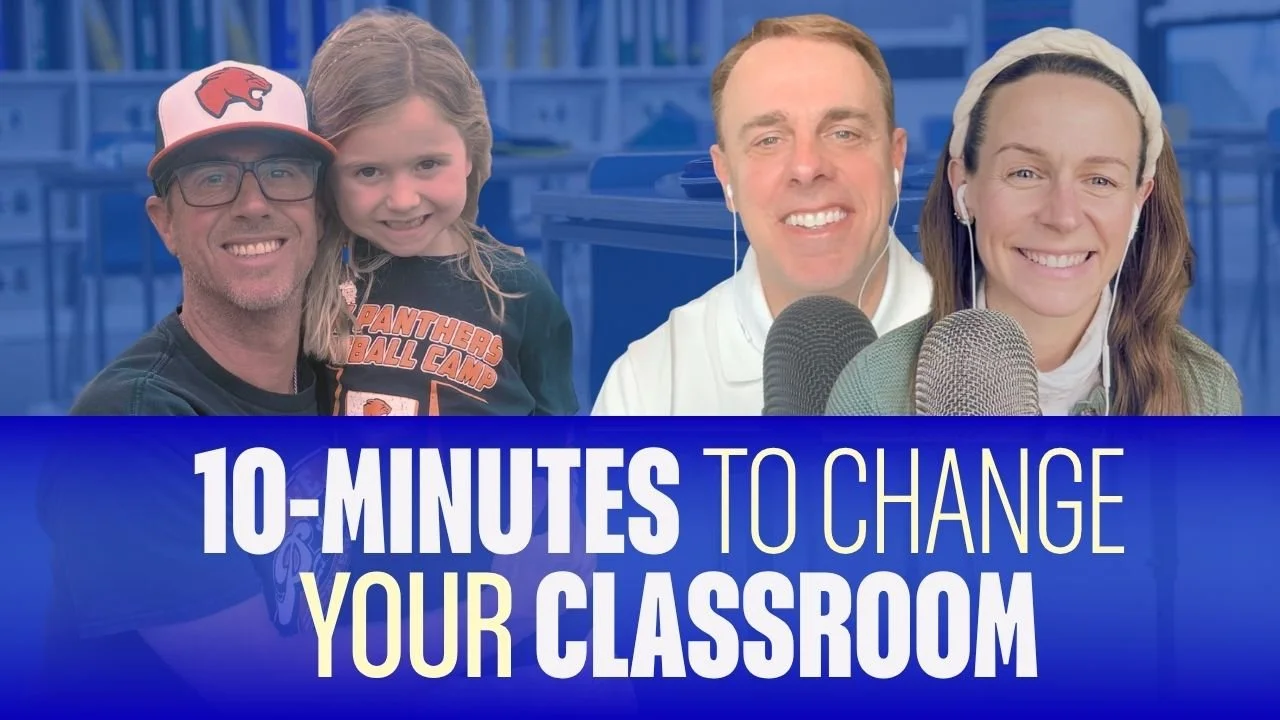
In this episode of the Raising Resilient Kids Podcast, Tom and Jeannie sit down with Justin Wharrie, a high school PE, health, and driver's ed teacher and coach, to talk about how he's built a simple, consistent mental fitness practice into his classroom using free videos on YouTube — just ten minutes a week, starting on day one of the school year.
Listeners will walk away with a real, classroom-tested blueprint for introducing SEL and mental fitness techniques to kids, handling pushback from skeptical students, and helping young people build the kind of resilience that carries them well beyond the classroom.
About Justin Wharrie
Justin is a teacher at Gardner-South Wilmington High School in Coal City, Illinois, where he teaches Driver's Education, Physical Education, and Lifetime Fitness. He also coaches basketball and baseball at the school. Justin came to teaching later in life — after more than 20 years working in road construction — and is now in his fourth year of teaching. He attended Illinois Valley Community College and graduated from Chicago State University, where he played college baseball at both schools. Outside of work, he enjoys golfing, swimming, and spending time with his six-year-old daughter.
Justin’s Favorite Mental Fitness Techniques
Complete Mental Fitness Technique of the Week Playlist (100+ Videos)
https://www.youtube.com/playlist?list=PLX5c7undf17cZO735JOBCrwhTcvgldLX5
Thank you!
Thank you for listening to the Raising Resilient Kids Podcast! We are siblings on a mission to help kids become their strongest selves. Each episode, we share proven strategies with parents, teachers, and all who work with youth and teens to build resilient, confident kids who can tackle life's challenges and thrive.
For more information on the podcast, or if you have a question you would like answered by one of our expert guests, please visit us at –
https://www.smarthwp.com/raisingresilientkidspodcast.
Special Thanks to Our Sponsors
Episode Transcript
Tom: [00:00:00] As the school year starts, now is the best time for teachers to build a consistent SEL and mental fitness practice into their classrooms. But who has extra time for one more thing? Today's guest has been doing it for years in just 10 minutes a week using free videos on YouTube, and it's changed his classroom culture.
I'm Tom…
Jeannie: …And I'm Jeannie. We are siblings on a mission to help kids become their strongest selves. Each episode, we share proven strategies with parents, teachers, and all who work with youth and teens to build resilient, confident kids who can tackle life's challenges and thrive. Welcome to the Raising Resilient Kids podcast.
Tom: Welcome to season four. Yay. Yay.
Jeannie: Happy beginning of the school year, everybody
Tom: I know, welcome, Actually to go back to last season, January's podcast, we, we talked a lot about the mental fitness techniques of the week.
Um, hopefully listeners, some of you listeners out there are using those. Again, those are the, the free videos we have out on YouTube, quick little [00:01:00] ideas on how to build resilience of yourself and the kids. I thought since it is the start of the school year, it would be cool to kinda talk to teachers about how they might use them in the classroom.
And I am incredibly excited 'cause I've got somebody who's been doing that for years now. Very excited to have Justin Wharrie as our guest today. Um, I actually met Justin, Jeannie, it was about four years ago. I was doing some Resilient Youth training at the school that he was at at the time. And I'm tremendously grateful that we've been able to stay in touch over the, over the four years.
We see each other periodically at, at, at PE and, and health teacher conferences, . before we jump into Justin, let me just give you a little bit of background on him. He's currently a teacher at Gardner South Wilmington High School in Coal City, Illinois, where he teaches driver's ed, physical education, and lifetime fitness.
He also coaches both basketball and baseball at the school. He actually came to teaching later in his life. He spent about 20 years actually working road construction, and now he's been a teacher for four years.
He attended [00:02:00] Illinois Valley Community College and graduated from Chicago State University, where he actually played college baseball at both schools. Outside of work he enjoys golfing, swimming, and spending time with his six-year-old daughter. Justin, thank you so much for being here. Welcome.
Jeannie: Justin, I've heard so much about you over the years. It is an honor to finally meet you.
Justin: Thank you very much, Jeannie. It's an honor to meet you too. I've heard a lot about you through Tom. Like Tom said, we met, like, four years ago, and, , we've had a good relationship ever since. We keep in touch. We've seen each other at seminars and I just, I just totally believe in what you guys stand for and your platform and your voice, and, I just wanted to be on board ever since the day that I met Tom, and done everything I can to help you guys and use your skills to help me, and not only in my classroom, but my personal life to, you know, make me a better teacher, coach, son, parent, friend,
Tom: Can you tell us about how you're using these, these videos in your classes? What are the benefits that you've kind of [00:03:00] noticed from using them? Maybe the, the culture of your class, how that might have changed using these?
Justin: I started in the elementary school, and now this is my second year in the high school. I find it really beneficial in the high school because I can relate to the kids a little bit more. And, um, and with me teaching PE and health, um, I've been able to introduce it in both of those classes, which is really nice.
The benefits that I'm seeing, of course, is obviously just, boosting their mood, helping them be calm, helping them breathe They live such busy lives, okay? . And I tell my students, "Hey, I w- I was a high schooler once too, but you're, you're dealing with a lot more stuff than I was dealing with."
The social media and the cell phones and, just the busy lives with sports and balancing school they're, they're just moving so fast all the time that I love introducing this stuff because they just need to calm themselves down and l- and, and work on their breathing and just be [00:04:00] more present, um, in the moment.
I tell them about all the benefits, you know, when I'm getting them to learn how to try to buy into this.
Tom: And I think that's important, t-talking about the benefits so they know what to expect out of it.
Justin: Exactly. So like, I told them about like they're gonna start getting better sleep at nighttime. They're gonna be more relaxed. They're going to be more focused. It goes down to our health triangle you gotta have all three aspects going. You gotta have the physical, you gotta have the social, and you also gotta have the mental. And that's why bringing it into PE and health, it's just, it's justified, um, because they need it.
It's, it's gonna help their mind and body interconnect, you know? Not just their body working out, getting their mental focus down and, um, and then we'll talk about all these things like with, with resilience. Like, things are ba- things are gonna happen. Like, everything's not gonna be roses all the time, you know?
You're gonna make some mistakes or some challenges are gonna come your way, and [00:05:00] how are we gonna cope with this?
Tom: Justin, how do you, how do you, like, incorporate it into your class? Can you maybe walk us through that for the teachers out there?
Justin: About weekly I try to do it. I do it mainly in my lifetime fitness class, which takes place in a, a weight room, It's a 54-minute class. So I usually do it the last 10 minutes of class once a week. What's very important to me is I start it the, uh, day one of the school year.
Once you start early, then you have all year for them to do it, get accustomed to it, and then they buy in a lot faster. You have to establish it right off the bat. I have a projector in my weight room I turn off the lights except one light, and, uh, we get Tom on there. Um, And we just start right off the bat And we do it the last 10 minutes of class usually just to kinda like calm them down.
They've been working out the whole class. It's perfect for cool down. It's perfect for when they leave to their next class.
Tom: Sure it is. Yeah, I agree completely. It's that, that last 10 minutes, you know, to kind of transition to that next class and, and the fact you start out at the beginning there is the, is the [00:06:00] main reason why I wanted to have you on as, as the season four, you know, opener essentially, because we got the start of the school year.
This is the time where they can start that up.
Jeannie: Justin, I'm just a little bit younger than you, so I remember, like, my favorite time in school was when they would, like, roll in the big tube TV with, and w- and I know we were gonna watch something. I remember those moments in time. I love the fact that, they get a second to, not that I'm sure they, they love having you up in front of them all day long, but it is a big deal to students when they see someone different.
It just kind of, like, switches their brain. So I love the fact that you actually are like, "Hey, sit down, watch this video of someone else different, you know, talking in front of you, and do it." It's such a smart way to try it.
Justin: Another thing just while it's on my mind, um, I do a lot of modeling too though. Like, even though Tom's doing it, I do that w- I do it with them.
I tell them like, "These are s-skills that you can do at home when you're laying down in your bed. You're trying to fall asleep, and you got all these things on your mind. You got a big test tomorrow.
You're, worried about your boyfriend or girlfriend or something, you know, and you're-- you can't [00:07:00] slow down your mind. Do some finger trace breathing.
Tom: I love it. I love it. Now, Justin, you mentioned a couple of them, the I am, the finger trace breathing. Are there a few out there, and we can link these in the show notes so
Justin: Yeah, I mean, I do, I do all of them. I do, uh, the concentration grids are great,
um, but I think that my favorite one would have to be the hot air balloon visualization,
and I think, and I think that that one really gets a lot of, uh, a lot of love and a lot of, uh, praise from our students.
Like, the first thing along getting them to buy into this when it's new, okay, I just have them space out on the floor, okay? And I just say, "My only rule is no talking and, and, and no phones."
When we do the, the visualization, the meditation, phones away and just, just don't disrupt anybody else who's trying to focus and breathe and do the exercise. Just if you don't wanna participate, that's fine, just be quiet and stay off your phone. [00:08:00] And, and a couple students do that at first, but then you see it as it goes a few more times.
Now they're starting to participate and they're doing those things.
Tom: Justin, you mentioned that you would, uh, during one of your teacher observation things, I think you said you did hot air balloon visualization
Justin: Yeah, I did. I did the hot air balloon visualization, and my principal really loved it. And, uh, he's a big believer in this, this kind of, uh, this kind of work.
Tom: Good. Great, great. And I just want to point out just I think it's important 'cause one of the, one of the pushbacks I always get from teachers is, " No, kids are gonna s- you know, there's gonna be some of my kids that are gonna think this is dumb." I think what you do is perfect. It's like you don't, don't force them to do it.
You don't have to do this, but you just can't disturb anybody else. You just gotta sit there and don't... And what I've heard over and over and over again from teachers like yourself is after a few weeks, everybody's doing it. Justin, do you have any examples of maybe students, you know, obviously you don't have to share any names or anything like that, but just a student that maybe it, it,
really [00:09:00] impacted
Justin: When I very first started this in my lifetime fitness class, I had two seniors that were really, like, pushing back at first. "This is stupid. Why do we gotta do this?" You know. And by the end of the year, the one student in particular, he absolutely gravitated towards it and loved it, and he would ask me almost every day, "Hey, Mr. Wharrie, can we do, can we do meditation today? Can we do, you know, some breathing exercises?" And, and then I s- if I see him around every once in a while, I ask him, I'm like, "Do- hey, do you still do these exercises that you learned?"
He's like, "Yeah, all the time."
Tom: What about misconceptions of teachers, especially like PE? 'Cause, you know, sometimes we get pushback. They're like, "Ah, this doesn't seem to fit in a physical education
Justin: Yeah, I mean, there are definitely misconceptions like, uh, "This is taking away from our physical activity time," is probably one of the biggest ones is like, um, but, the studies will show, as you guys know, that, that this actually helps PE. All these things are helping save time because they're [00:10:00] staying more on task now. Um, they're, you know, they're paying attention more. They're, they're focused more. And now they're getting more out of things because they just have a better outlook.
Tom: Being an athlete yourself, playing college baseball, and now you're coaching baseball and basketball, do you use these with your athletes at
Justin: Yes. Of course I do.
So I talk to them about, a lot about r- uh, about George Mumford, who I've done some research on. He worked with the Chicago Bulls, in the '90s when they won their six championships, and he was a sports psychologist, a mindfulness teacher who Phil Jackson brought in to help the Bulls.
There was a pushback at the beginning of that too with the Bulls. Michael Jordan and Scottie Pippen were the ones that really gravitated to the most, you know, and they got the most out of it.
Jeannie: Yeah, and I think it does help, you know, young student athletes when they see or hear about these stories of these professional athletes that have succeeded so much and how much they prioritize the mental aspect of it. Of, I, I would think as, I'm not an athlete, but I would think as an [00:11:00] athlete, that would s- at least kind of plant a little seed in my head.
Jeannie: And now a word from our sponsors.
Tom: Listen to this. Her confidence is off the charts. She's playing like I've never seen before. That's what one parent said after their daughter completed Mind of a Champion. This proven mental training program teaches young athletes goal setting, visualization and mindfulness techniques that work both on and off the field, ready to unlock your athlete's potential?
Check out the link in the show notes for more information.
Jeannie: Back to the podcast.
Justin: Like for, for basketball, for example, like when I'm teach- when my kids are shooting free throws, I will go up to them on the side and I'll be like, "Okay, now close your eyes for a second and just visualize the ball, you shooting with form, or you could even do the sh- the, the shot without the ball, but close your eyes and visualize the ball going through the net."
You know, that positive reinforcement right off the bat. Get, get rid of these negative emotions. Close your eyes, do a [00:12:00] little visualization, watching that ball go through the net.
You're training your mind, you know, all these mental fitness techniques. For baseball, a pitcher maybe throwing strikes or whatever, you know. Just close your eyes a little bit before you throw that pitch and just imagine you throwing a strike. You hit in the middle of that catcher's mitt, you know.
Just that quick visualization, that quick, you know, breathing, you know. It's gonna help,
Tom: All right. Well, hopefully we've convinced the teachers out there
to, to start to, to do this. Yeah. Um, but J- Justin, I guess, you know, if, if for those that we have convinced, what, what would you suggest? How would you walk them through how, how to get this started in their classroom?
Justin: I would suggest you guys into doing a little research on you guys and the, like, kind of what it's all about first. I think that's the best way.
I think it really is gonna work if you buy into it too personally. Um, I, I mean, it's-- You gotta be real. You gotta be authentic. You know, I think that's one of my things that I really pride myself on is, is yes, I'm not perfect, but at least I'm authentic and, um, being real [00:13:00] with your students and showing them, like, with the modeling and, , you're all in on this.
You believe in this. You're pushing this, and you're pumped up about it,
You know, like, with the kids, you know, they're moving so fast. They're-- They can only take little bits at stuff at a time usually. My exercise is keeping them short, like two to five minutes, maybe 10 minutes max or whatever, and then, uh, starting small like that and, uh, and then just also don't get frustrated with some pushback at first.
And then o-open discussions with them.
I'm like, "Hey, just let me know. Did the-- Do you feel better after this exercise? Like, and if you don't, just tell me you don't. It's fine. You're not gonna lose out on points on your grade." You know? Just I want honesty, you know. Then I can find out what things worked, what things didn't work.
Did they like this video? Did they like this video? But then you find out the more you go, the more they start talking about the benefits. Like, "Yes, I feel m- more relaxed, Mr. Wharrie. I feel more calm. I feel like my [00:14:00] mind is more clear. I feel like my muscles feel a little bit better.
Like I said, your mind and, your mind and your body, it's just, it's gotta be connected.
Tom: Justin, this has been fantastic. Any final thoughts? Any final advice for…
Justin: Like I said, I love, I love what you guys stand for. I love your platform, and just keep on keeping on. Up with the good work, and, uh, l- I'm gonna keep on doing it in here, in my classes, because I've been seeing great benefits and, getting the kids to think outside the box a little bit.
Like, "I know that you guys got a lot of things going on right now. Here's the tool- some tools that I can do to help you." I wrote down a couple things I wanted to look at, um, for sure, just I want to read word for word but like, I wrote that like, "Resilience isn't built by avoiding stress.
It's built- it's built by helping kids handle it well." Right? Like, things are gonna come our way no matter what. So how are we going to handle it the best that we can handle it, and then also, "Resilience isn't something that you give kids. It's something that you help them [00:15:00] practice."
We don't have all the absolute answers right off the bat. We're giving them something, some practice, and that's why I love it, too, because they can take this with them home, you know? This is something that I tell them that you will use the rest of your lives. So I'm giving them skills that not only are they gonna use here in school with me, they can start using it now at nighttime, they're gonna be using it when they graduate school, they go to college.
They have tough things that come their way, you know? These kids need this more than any time ever. Their life has never been busier than it ever has been before. Even for me, even for everybody, and especially our kids, and like, people like us, like we, we try to think that we know what's going on in their lives, and we try our best, but we don't know.
They have a lot of stuff going on that like we wouldn't even think of, you know?
Tom: Justin, those kids are lucky to have you as a. teacher. Thank you so much for being here. Thank you for being our guest.
Justin: I lo- I love my kids. I love my students. I'm very grateful for, uh, coming to school every day and trying to be a leader and help out these kids because they need to [00:16:00] be, they need to be loved, and I want school to be the best part of their day.
Tom: That is a great way to end. Thank you so much, Justin, for being here.
Justin: Thanks. guys.
Jean: Season four. First guest of season four, and Justin is awesome!
Tom: I knew you would like him. He's a great guy. Fantastic guy!
Jean: Such a great guy, and I feel like I've heard you... His name has come up so often, and what I didn't realize until this conversation is that, he started his teaching career relatively recently, despite him being closer to middle-aged.
Sorry, Justin, you're about the same age as me, so I can call us middle-aged.
Tom: You guys are much younger than me though, so
Jean: Exactly it, we're younger than him.
Tom: Yeah
Jean: you know, he sort of, he started this new career a little bit later in life, I always hear that those first few years of teaching are the most difficult years. You're finding your footing, you're figuring it all out. The fact that he's prioritizing this, first of all, the wonders I'm sure that it's doing for the kids in his classroom, but I think it also shows the trajectory of where we all are as a society. That we're recognizing, hey, it's not only just [00:17:00] important for kids to be doing well and to be supported academically, but also mentally.
Tom: Agree completely
Jean: Now what about for you? You obviously have known Justin a long time. You've interacted him with a ton. What was something that, you know, came from this conversation that stuck out to you?
Tom: Yeah, the, the one thing I'd wanna highlight is just the fact that Justin models the, the, the techniques too. So he's doing them, you know, he's putting d- my, my face on a projector, which I'm not too excited about, but then he basically does it with them. He'll cl- you know, close his eyes. Obviously, he's keeping an eye on the classroom too to make sure that, you know, they're, they're, uh, engaged.
But it sh- it shows a great example, for the kids. It shows, you know, this great role model, and then it's also, I'm sure, helping him too. I mean, teaching is a, an incredibly stressful job, and you've got stuff not only with, you know, as, as a teacher, you're, you've got stuff that you're dealing with in the classroom and at home and everything like that.
So it gives him and, you know, other teachers who are doing this a mental bl- a mental break as well,
Jean: And putting you on the [00:18:00] screen, it gives him that mental break, but also kind of gives him that, like, 10 minutes once a week where he doesn't have to be the one, doing all the bells and whistles. He can say like, "Okay, we're all, myself included, we're all gonna sit down and we're gonna watch just this couple-minute-long video and do this exercise."
It's, it really is, it gives a, a teacher a break in so many ways, but a beneficial break.
Tom: Yeah. Yeah, I would agree. I would agree. And then the other thing I, I wrote down a couple of his quotes that I just loved. Um, one was, "Resilience isn't built by avoiding stress. It's built by helping kids handle it well." And then re- "Resilience isn't something you give kids, it's something you help them practice."
I thought those were fantastic quotes.
Jean: For those people that are watching our, uh, our, this podcast, you see him look down and like he, he writes that down. You can tell that's like a mantra, something that he really keeps and holds close to him, the importance of him writing it down. He obviously lives that and does that in his classroom day in and day out.
Tom: Well, great, great first episode of season four. We've linked, uh, Justin's favorite videos in the show notes as well [00:19:00] as the, uh, the playlist to all 100-plus videos of the, the mental fitness techniques of the week that you can use in your classroom or with your kids at home or in, in any way that you work with kids and teens.
Jean: I hope that the back-to-school season is going well for all of you. For those of you that you are feeling stressed, check out that playlist. It will certainly give you those couple minute break that you might need during this stressful time of the year. Thank you so much to all of you for listening, and we'll see you next month.