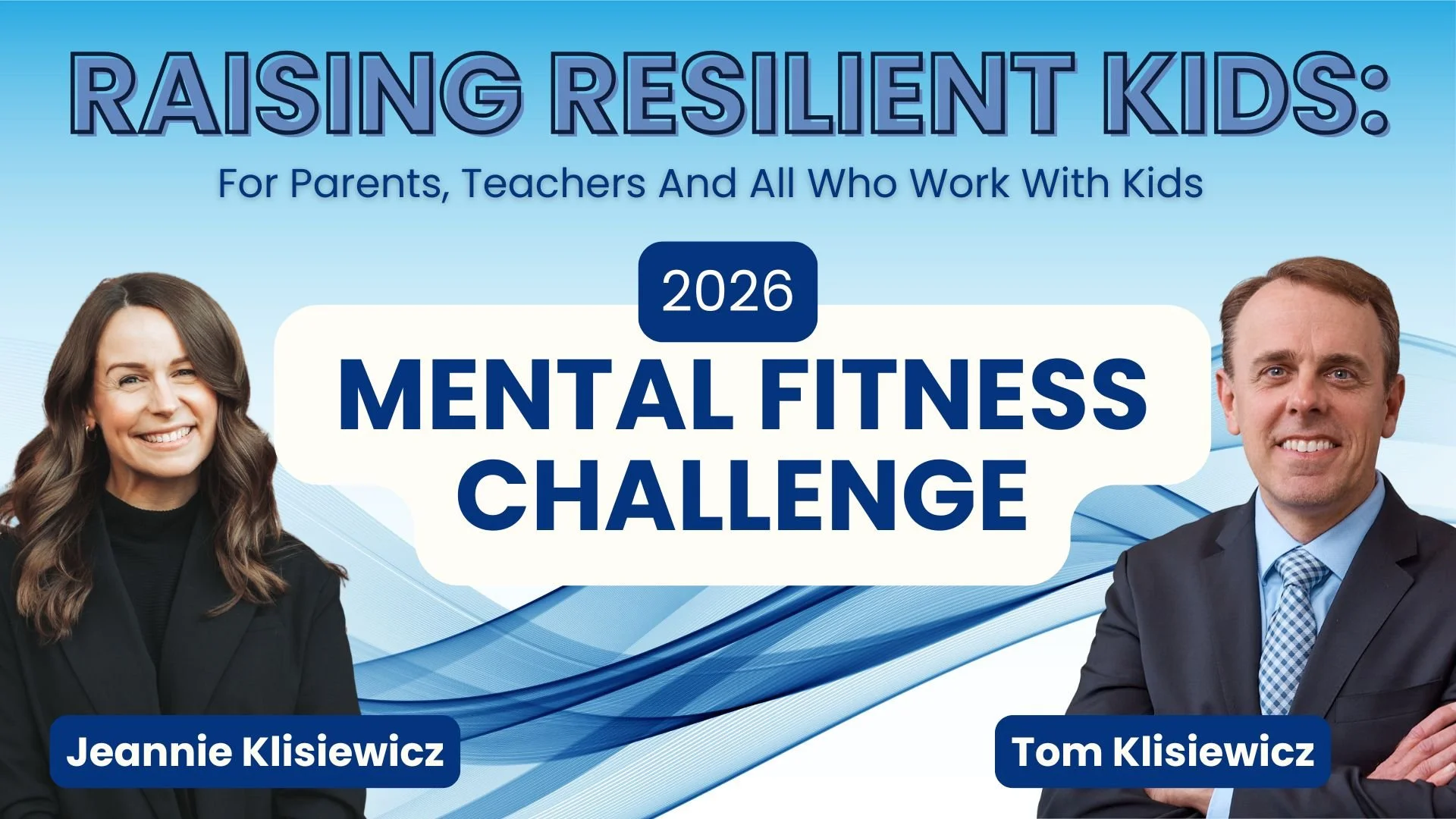
Mental Fitness Challenge 2026: Build Resilient Kids One Week at a Time (with the summer off!)
Check out the podcast on…



Looking for a New Year's resolution that creates lasting impact for you, your entire family, or your classroom?
Join hosts Tom and Jeannie Klisiewicz in the 2026 Mental Fitness Challenge—a simple, research-backed approach to building resilience through 36 weekly techniques that take just minutes per day.
Specific Strategies You'll Learn:
How to access 36 free mental fitness techniques releasing weekly throughout the school year (with a summer break!)
The "Ritual for a Fulfilled Life"—Benjamin Franklin's approach adapted for modern times
Why popular techniques like Five Finger Breathing and the Concentration Grid help kids manage stress and improve focus
How teachers across Will County, IL are using these 2-minute videos as transformative classroom brain breaks
Why consistency matters more than perfection in building mental resilience
About This Challenge: Starting January 8th, new techniques release every Thursday. Each video is professionally produced, evidence-based, and designed for all ages—from kindergarteners to adults. Whether you're a parent looking to strengthen family connections, a teacher seeking classroom tools, or simply someone committed to better mental health in 2026, this challenge offers a structured, supported path forward.
Ready to Join? Sign up at www.smarthwp.com (Resources > Two Minutes to Resilience) or subscribe on YouTube to receive weekly videos. Let's make 2026 our most mentally strong year yet—one week, one technique at a time.
Thank you
Thank you for listening to the Raising Resilient Kids Podcast! We are siblings on a mission to help kids become their strongest selves. Each episode, we share proven strategies with parents, teachers, and all who work with youth and teens to build resilient, confident kids who can tackle life's challenges and thrive.
For more information on the podcast, or if you have a question you would like answered by one of our expert guests, please visit us at –
https://www.smarthwp.com/raisingresilientkidspodcast.
A Special Thanks to our Sponsors
The So Happy You're Here YouTube Channel
The Resilient Youth Certification Program
Episode Transcript
Tom: [00:00:00] Looking for a New Year's resolution that actually makes a difference, not only for you, but also the kids in your life? You're in the right place. In this episode, we are kicking off 2026 with our Mental Fitness Challenge, a simple weekly practice designed to build resilience, strengthen focus, and boost emotional wellbeing in just a couple minutes a day.
These are small habits with a big payoff, and we hope you'll join us in making this our most intentional and mentally strong year yet. I'm Tom…
Jeannie: …and I'm Jeannie. We are siblings on a mission to help kids become their strongest selves. Each episode, we share proven strategies with parents, teachers, and all who work with youth and teens to build resilient, confident kids who can tackle life's challenges and thrive. Welcome to the Raising Resilient Kids podcast.
Tom: Happy New Year!
Jeannie: Happy New Year!
Tom: Happy 2026.
Jeannie: Can you believe it?
Tom: It's crazy.
Jeannie: How is it 2026?
Tom: I know.
Jeannie: Where like I just, it's the holidays were so wonderful. Of course, I have the [00:01:00] post holiday sickness, doesn't everybody, at least in one household get it?
Tom: Too much time with family and friends.
Jeannie: and too much fun. Too many cookies. Not enough sleep.
Tom: Yes. 2026. What is happening in the United States this year being 2026?
Jeannie: Okay, being 2026, what's happening in the United States? Oh, and you didn't tell me before this, you were gonna quiz me.
Okay. This is wrong, but because I'm in LA we have the World Cup.
Tom: Uh
Jeannie: Is that not it?
Tom: Oh. That's, that's kind of true.
Jeannie: Oh, man.
Tom: It's the 250th anniversary of 1776
Jeannie: I knew, honestly, I knew it would be about history because it's something to do with you. I literally
Tom: Of course.
Jeannie: something about American history? Of course it is.
So tell me 2026. It's new year resolution time. You're always a resolution guy.
One of my favorite resolutions that you ever did, I don't remember how many years ago it was, but was when do you remember this? You did a different resolution every month.
Tom: Yeah.
Jeannie: [00:02:00] That was such a good idea. So much so that I stole it the next year and I remember one month it was like, I'm like, that's a great idea.
I remember one month every night I sat and tried to learn all the countries in Africa and be able to like place them geographically on a map.
Tom: Wow, that's, can you still do it?
Jeannie: Nope, definitely not. Definitely not. Could do it at the end of the month, but, nope.
Tom: I'm sure you could do more than I know though.
Jeannie: Maybe it was embarrassing when I went back a few months later. I'm like, wow, our brains sometimes are sieves and it went all right through.
I remember one month I was vegan. I have to find the list of other things that I did, but that was such a fun idea of New Year's resolutions. What, do you have any this year or what are some of the past ones in years past that you've really liked.
Tom: No. Yeah. And that, that monthly one. I did like no pizza one month, no dessert. One month. There was one year, I think you did this with me, where we put cash in an envelope and every month just picked a random address in the United States and mailed it [00:03:00] and completely anonymously, didn't, no return address and sent it and somebody just, hopefully there were people living at that house would open it up.
Jeannie: Seriously.
Tom: and they got some cash. That was kind of a fun one.
Jeannie: I don't remember how we picked the addresses we sent it to. You always have such good ideas.
Tom: I think it was just plotting on a map and looking up on Google Maps and finding one address of a house that looked like it had people in it.
Jeannie: So 2026, what, what are you excited about for the upcoming year? What are you looking forward to?
Tom: I'm excited about some more podcast episodes with you.
Jeannie: Got some very good guests coming up in the new year.
Tom: Yeah, I'm excited about, well, Mind of a Champion. We just launched that last year, so I'm excited for that. Obviously it's a course I've been teaching for I think A dozen years now, but we got the, the electronic version, so I think that's probably one of my resolutions or goals is to spread that too, as many people as possible.
Jeannie: Yeah. I'm so thrilled with how that came out. When you came to me and said, okay, I wanna put this , course it's, it's four classes, there's all these bonus [00:04:00] videos in between. Like when you said, okay, I wanna make it a digital course, an online course. I was like, okay, this feels really daunting.
And even as I was editing it, I'm like, what did I agree to?
Tom: But you benefited from it. Because you use it for softball and I've never seen you hit the ball in the outfield in my life, and you were able to do that.
Jeannie: Exactly. No, truly. I mean, I'm proof that it works, but also like I feel like we've gotten to do so many really fun things as I've come in and started working more with you, I've gotten to like learn so much, but being so immersed in that course.
There are so many things that I carry with me. So many techniques and tips that you give in that class that I use all the time in regular life, and Nick will say to me, even when we were talking about New Years resolutions, he's like, is that a SMART goal? Is it specific? Is it measurable? Is it attainable? Is it relevant? Is it time-bound? I'm like, okay. Somebody was paying attention during their Mind of a Champion while they were helping me, you know, edit to make sure nothing was wrong.
Tom: Poor Nick and mom who had [00:05:00] to watch all those videos to double check everything for 'em, but thank you to them.
Jeannie: Yes, agreed. Thank you to them. But I just think it really, not only are so much of it relevant, but I'm so proud of how that course turned out.
And so much of what we did in that course, the way that we edited that course to make it, I think really fun, and interactive and engaging we've been able to do in this year's upcoming mental fitness techniques of the weeks, which you've been doing for what the past two,
Tom: This is the third year going, this is the third year of the official videos that like that you, you've been helping me with. So it is something that I did prior to that, but they were more kind of email tips that I would send out. But these look a heck of a lot better than an email text.
Jeannie: I think the fun thing about this like editing journey and being able to be so involved in, in a lot of the marketing material and the videos that you've created and putting things online is watching myself and my own skills improve over the years.
[00:06:00] Obviously I, I worked in entertainment, but I did a lot more things on camera, not actually like physically editing a video and I'm just so proud of how these turned out on my end and how we've edited them and made them so engaging. But also the techniques that you've given this year, I'm already through editing them, I'm implementing them into, into like my daily life.
It's just they're, I really think they're like, these are your best techniques yet. So for our listeners, before we really dive in to what the challenge that we have for our listeners, can you share with them what is a mental fitness technique of the week? Where did this idea come from?
Tom: So, so the idea came from, I do training and resiliency training for teachers and coaches and different things like that. And it actually came from that. So there's this Resilient Youth curriculum that I learned through the Benson Henry Institute and they kind of trained me on it, became certified to do it.
But one of the feedback when I was teaching it over the years, one of the things that that people always ask is, you know, this is great, but I don't have that much time in class. And it's [00:07:00] important that they don't just get this trained once that it's constantly being reinforced. So as a result, I kind of came up with these quick little techniques that teachers could use that just take a minute out of the class.
They could do it right at the beginning of the class, right at the end of class. Or parents could use, you know, right at the end of the day, just try it out with their kids. Coaches could use at the beginning of practice, end of practice, anything like that to give them new techniques because everybody's different.
So the idea is, let's give kids and adults a whole bunch of different techniques to, to try out and then figure out what, which ones work for them when they're really stressed, they're really anxious, they just wanna, live a happier, healthier life.
A few of these I came up with on my own, but many, I, most of 'em, I learned from many other wonderful people who've taught me over the years, or, I've heard from podcasts and things like that. Initially they were just emails and they kind of grew into these, these videos to, you know, that you've done a phenomenal job, um, recording. I've had people, you know, mention that, Hey, you know, how do you do [00:08:00] that? Speaking to me on the camera? They're just smooth and I don't mess up and I'm like, there is a ton of mistakes, a ton of me swearing at myself. Um, and the
Jeannie: The blooper video
Tom: Yeah. The blooper videos.
We'll, we'll, yeah, will demonstrate that. But, but you know, I think they're, they are really engaging. I was just at PE Health teacher conference in December, and I had a couple people come up to me and say how they're still using the videos that they, got three years ago, that, that they're finding value in it.
One, one guy, Justin, if Justin, I'm sure you're out there listening, but, he was talking about the hot air balloon one, which is something I learned from a book by Tara Swart. And basically kind of adapted that so it was a little bit more shorter and for kids. Um, he said he still uses it to this day.
His principal was actually observing his class and he used that one. And the principal actually mentioned, yeah, that's a great technique. Where'd you find that out? So it's, it's kind of cool. yeah. It's cool that they continue to be used.
And now a word from our sponsors.
Jeannie: Is your [00:09:00] young athlete struggling with nerves, lack of confidence, or getting stuck in their head during competition? Mind of a Champion solves this. This program gives kids a mental toolkit to stay focused under pressure, bounce back from mistakes, and perform their best. These aren't just sports skills, they’re life skills. Check out the link in the show notes for more information.
Tom: Back to the podcast.
Jeannie: You really do such a good job of making them digestible and quick. 'cause of course, teachers and parents, they don't have a ton of time in the day, But the reality is that all of us, kids included, maybe kids, um, most of all have really short attention spans.
And so we don't wanna, sometimes it's hard to sit through a really long lesson to learn these things, and you just make it so, snap done. Here it is. Give it a try this week. And you've been able to pull from all the research and all the work that you've done over the years of, of building your company and been able to take it and put it into these. It's just, it's just awesome. And [00:10:00] tell me too, like, I, I've never asked this, I know you, United Way is a big supporter of these.
How did they become involved and, why did they think that it was important to, to nurture this idea?
Tom: Yeah, so, so that was, again, probably three or four years ago now, I think we got a grant through the federal government, to be able to roll out the, this Resilient Youth program, the Benson Henry Program to schools in in Will county, the county that they support. And part of that, when we were thinking about the program, and what to offer teachers, we didn't, we wanted to give them the continuous support.
We didn't just wanna go in and just train them and say good luck. Um, so we added on a number of different things to help, to continue to support them throughout the year, which is like office hours that I do, if they if they have questions, they just email me, we get on a Zoom, my email and back, whatever that is. But I also wanted, take the time to actually create these as videos so that they can just, instead of reading an email, if they don't feel comfortable, they can just pull it up on YouTube and hit play and show their students.
And that's what a lot of 'em [00:11:00] are, are doing.
Jeannie: That's a brain break within itself.
People talk about those brain breaks, that's a brain break. Say, okay, let's sit here and watch this video.
Tom: Exactly, and then I can guide it through 'em. You know, they can just look, watch themselves and do it with their kids, but a lot of times the kids like just a different face, you know, a different person. So playing the video. So we did it first year, very successful and, you know, got a lot of good feedback on it, so a huge thank you to the United Way of Will County 'cause they're able to support it for, 2025 and now again in 2026.
And now we're starting to go into like YMCAs and other charitable organizations in that county and offer the same thing to them.
Jeannie: So I wanted to ask like, what are a couple of your favorite techniques? It could be maybe from past years or maybe teasing to some of the upcoming ones.
Tom: Let me give you a few. So one, probably my favorite technique that I talked about is the five finger breathing. And that was the one where basically you breathe in, you inhale, you exhale, and you put one finger together. And then basically you do that five times. We can link it in the notes so people, people can access that one.
But I really like that one 'cause it kind of trains the brain [00:12:00] to associate your fingers being together with five breaths, kind of getting in from the stress response into the relaxation response. So we've got 'em all on the YouTube channel, and they're, and they're kind of organized by the most popular.
And the one that comes up, I think in like the top 10 or the top 15 both is the concentration grid.
Jeannie: Explain that one. 'cause that's
Tom: So basically, yeah, it's, it's, it's a, it's, it's a whole bunch of numbers.
So we have the numbers, um, I think one, one through 100. I think this year we did one through 36,
Jeannie: Mm-hmm.
Tom: just to make it a little bit more achievable, if you will. Um, and then the idea is you got one minute and you have to find the number one and then two, and see how, you know, how high you can get up to.
We just did it normally in 2024 and 2025, we threw in some distractions. And now in 2026, we got another little, bit of a change to it to make it a little bit more difficult. And, but I think some people that were, that have been testing it have gotten pretty close to getting all 36 numbers.
Jeannie: I was gonna say, Nick came pretty close. My husband always, whenever I edit these, he's my double editor or my checker to make sure that I didn't like mess something up or something looks really funny. And whenever I'm like, okay, I [00:13:00] need you to do this one.
And concentration grid comes up, he's always like, oh, this is one of my favorites. And so is, um, imagery memory game.
Which is where Tom will put up a picture and you're gonna study the picture. He takes the picture down and then he asks you five questions about the picture. And he loves that one.
Tom: We got one of those coming up in 2026 as well. They are popular. Yeah.
Jeannie: So this podcast episode really is kind of all rooted in when I was editing one of the videos from February because there's a technique that's going to come out this February of 2026. And when we were filming it, and then when I was editing it, I. I, number one, thought it was such a great idea and I also couldn't believe that this is something that you've done. Like you're my brother, I know you very well. I had no clue that this was something that you've been doing for as long as you've been doing it, and it's called the ritual for a Fulfilled Life, so 15 or or so. I think years ago you started doing something that you learned about from, I mean, really you're tying this all together. You talk about the 250th American history, 250th birthday. [00:14:00] You learned about this from good old, one of the founding fathers, Benjamin Franklin. So explain that technique and tell us about it.
Tom: So, yeah, so he had, he had these 13 virtues that he wanted to live up to. And essentially he would, he would evaluate himself on how well he was living up to those virtues, each and every day. And kind of have a weekly scorecard, if you will.
So it all, the personal, I mean, you know, since I was in high school, I've was. Kind of thinking about this stuff and reading about this stuff. One of the things that always comes up is, all right, you gotta have like a mission for your life. What do you see as your ideal life? So what I did was I kind of identified six areas of my life that I wanna excel in. From marriage to fatherhood, to friendships, to, physical and mental health, to financial, to career, you know, the, the, the, business and everything like that.
So essentially what I did was I created these mission statements. Then I do, kind of like Ben Franklin did, is at the end of every [00:15:00] day, think about 'em in the morning just to remind myself, okay, as I go about today, I wanna be a good husband, I wanna be a good father, I wanna be a good friend, I wanna be healthy, I basically kind of jot down what I did. So let me see. Hold on. Let me
Jeannie: Ooh. Ooh, this is exciting. I mean, I can't believe you do this every single day.
Tom: Yeah. Now I, I should say. Almost every day. You know, obviously there's times you're sick or things like that,
Jeannie: But also we, let's be real, who does something every single day, except for brush your teeth. I hope you all brush your teeth every single day. But what I'm saying is that this is something that you've been doing for so long. The fact that you do it consistently, I love that. It's this consistent practice.
Okay. Oh, this is it.
Tom: You get a journal and just kind of write down. There we go. You can see all this stuff in there. But, but, but basically then I have one through six and then I write down, okay, what did I do that day that brought me closer to that ideal? It's, it's the way I wanna be, the way I wanna live. So it's, it's something that you have to consistently do. And then what I love about it is it, it kind of reminds me that I wanna take at least one step in a positive [00:16:00] direction towards that ideal, every single day.
And I don't get to all of them every single day. So, so I kind of can kind of notice, all right, if I've been missing out on the friendship stuff, for a few days, alright, I really need to think about that and put, put more effort intothat so I can kind of round that out. But it's not, again, all of these techniques, this is something that works for me.
I'm not, you know, I, I, that's why we throw out all these techniques to try 'em all, is what I always say. Figure out which one works for you and run with that.
Jeannie: I'm just so excited for what you've curated this year, you've done just such a great job, and you came out October of last year to film the videos and you know, I've been spending the past few weeks or many weeks editing them and I realized, like I, I definitely do incorporate a lot of these techniques into my every day. But every week we launch these videos, during the school year, and you encourage people, give this a try every day this week come back here then and comment on it, or whatever. And I realized, I'm like, oh, I don't, I guess I don't really do that.
So I decided that [00:17:00] my New Year's resolution for 2026 is I am going to every week do that technique every single day so that I am doing all 36 of them.
And then at the end of the year, I can decide which ones I wanna take with me and which ones I wanna leave behind. And I thought it would be really fun to ask the listeners of our Raising Resilient Kids podcast to join us on the challenge, to join us in on the resolution.
So we're, it's 2026, maybe you have resolution, maybe you don't. I just feel like this is something that's really doable. We have a tendency to focus so much on our physical health. Like, I wanna lose five pounds this year. I want to eat healthier. But you talk all the time about how mental health is just as important as our physical health, and I think that this is a really easy, fun way to do it. You can join along. You know that a group of people are, are doing it along with you. So tell people how they can do this. Give them the tips.
Tom: Yeah, no, I, and I think doing it with your kids too, this is all about raising resilient kids. So videos are released on Thursdays. So the first one [00:18:00] I think would be January 8th, and like you mentioned, it's just during the school year, so it's basically January through May and then August through December.
There's a number of different ways. Probably the, the two best ways to access the the videos would be one you can sign up on, on the website. So if you go to www.smarthwp.com, again, we'll have a, a link in the, in the videos. But if you go to resources and then two minutes to resilience, under the resources drop down menu, there'll be a form that you can fill out that has your name and, add your name and your email.
And then you'll get the tips emailed to you. You'll notice when you get those tips, they're directed at people who are working with kids, so parents and teachers and coaches and things like that. So they'll say, Hey, this week, do this with your kid. But when you watch the videos, you'll notice there are things that are gonna benefit anybody of any age.
Jeannie: Yeah, a hundred percent.
Tom: Yeah. Exactly. Yeah. The other way, if you don't want to send an email or sign up if you just on, the YouTube site. So if you want to just go to our YouTube channel again, we will connect that. Or you may be watching this on YouTube.
If you just [00:19:00] subscribe, we release 'em on Thursday on YouTube, and then we send 'em out through the email.
So yeah, that's a great idea. That would be, that would be a lot of fun. Have everybody join in the challenge
Jeannie: yes, exactly. Joining the challenge again, it's quick, it's easy, it's simple. You get the summer off of your New Year's resolution. That sounds pretty great to me to be able to go. I'm just gonna take a little break and it may be kind of fun to use the first semester or the first half of the year, I guess I should say, utilizing those techniques throughout the summer and then you start up again in like mid-August, I think it is with, with the, with the latter half. I'm sure there's some statistic about how like the third week of January or the middle of February, like everybody's New Year's resolutions are sort of like off and they've forgotten about them or whatever. This is something new every single week. And
Tom: It's a, a weekly reminder.
Jeannie: Exactly, it's doable. It's manageable. It is something that you can do with your kids, with your partner. You could do it by yourself. And you are right, these techniques are for everyone. I'm just really, I'm really excited to do it. I'm excited to do a resolution. I am committed to do [00:20:00] all 36. Tell us like too, why do you think that this is a, a good challenge for people as someone who has really studied this for so long?
Tom: Yeah, it's, it's great because it's, it's that consistency. It's the consistency that matters. So just learning this stuff doesn't matter. Doing it once or twice is not gonna help you.
It's the consistent daily practice of thinking about these things. Hey, I need to, you know, calm myself down. I need to make sure I'm not in that toxic stress. I need to practice gratitude and just the fact that you could do it with your kid, raising resilient kids is all about, you know, one of the big things, spending time giving your kids these tools, and this is a way to do it on a weekly basis, together, you could do it as a family or if you're a teacher to, to all of your classes or a coach, you know, once a week before each practice or whatever it may be. There's a lot of different ways to apply this so I think this is great!
Jeannie: Come on everybody, let's do this together, right? Let's join us at the end of 2026 we're gonna be feeling so good mentally, and we all know that when we're feeling good mentally, it just helps every other part of our life. So, [00:21:00] so join us in this 2026 New Year's Resolution. And brother, once again, you do everything better than me. You're so smart. No, you're so smart. And I'm really excited to do this this year and I'm excited for the rest of our podcast episodes in the coming months.
We've got some really great guests that you've lined upt
Tom: We do. Yep. Awesome.
Jeannie: Awesome. Well, thank you so much for listening. See you next month.