
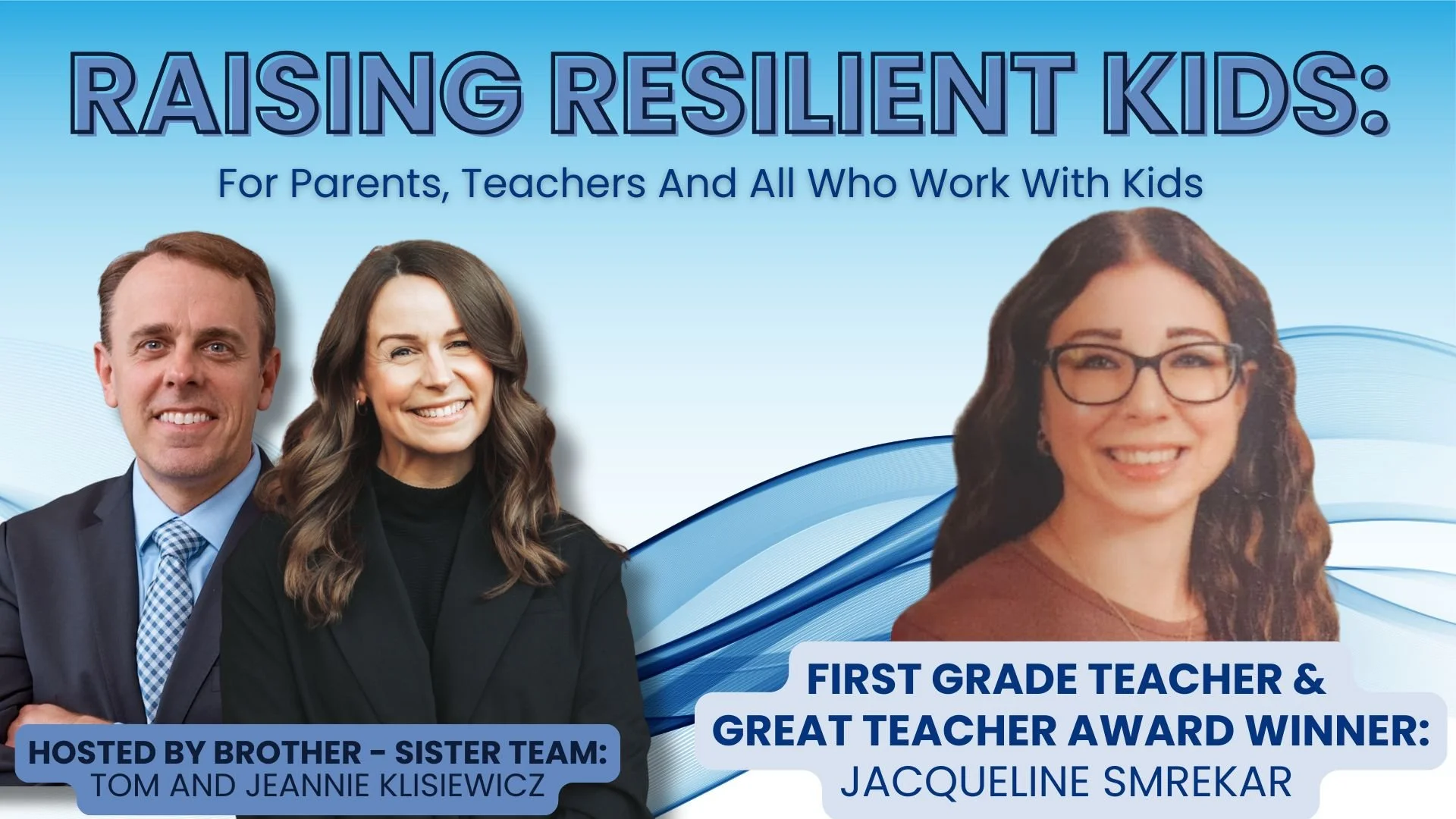
How to Make Your Classroom a Safe Space with 1st Grade Teacher Jackie Smrekar
Check out the podcast on…



What if the secret to a thriving first-grade classroom wasn't rushing into academics, but investing three weeks in emotional safety? Jackie Smrekar, an 11-year veteran first grade teacher and Great Teacher Award winner, reveals exactly how she creates a "classroom heart family" where six-year-olds learn to identify their emotions, self-advocate, and resolve conflicts independently.
In this episode, Jackie shares her complete framework for building resilient first graders, including:
Why she "shys away from academics" the first three weeks and how this investment pays dividends all year long
The 20-minute morning routine that sets the tone for the entire day (and how intermediate teachers can have students lead it)
How to set up and use a calming corner that students access independently when they need emotional regulation support
The Slumberkins curriculum (https://slumberkins.com/) and how stuffed animals teach mindfulness, authenticity, and stress management
Real-time conflict resolution strategies that turn classroom disputes into learning opportunities for the entire class
The transformation of a student who hid under his desk to a thriving second grader who self-advocates for his needs
How restorative circles create safe spaces for sharing (even when it feels uncomfortable at first)
The power of teacher vulnerability in modeling that "feelings come and feelings go and all feelings are okay"
Specific ways to collaborate with school social workers and SEL staff to maximize support
Jackie proves that when you front-load resilience tools and create consistent, emotionally safe routines, students aren't just better behaved—they're better learners. If you're an elementary teacher wondering how to fit SEL into your already-packed day, or a parent looking to understand what emotional safety looks like in the classroom, this episode gives you a complete, actionable roadmap.
Guest Bio
Jackie Smrekar teaches first grade at Farragut Elementary in her 11th year of teaching. She serves on her building's character committee and leadership team, and is certified in Teacher Clarity. She won the Great Teacher Award in 2020 from the Joliet Region Chamber of Commerce.
Resources Discussed
Slumberkins - https://slumberkins.com/
Second Step - https://www.secondstep.org/
Thank you
Thank you for listening to the Raising Resilient Kids Podcast! We are siblings on a mission to help kids become their strongest selves. Each episode, we share proven strategies with parents, teachers, and all who work with youth and teens to build resilient, confident kids who can tackle life's challenges and thrive.
For more information on the podcast, or if you have a question you would like answered by one of our expert guests, please visit us at –
https://www.smarthwp.com/raisingresilientkidspodcast.
A Special Thanks to our Sponsors
Episode Transcript
Tom: [00:00:00] What does a stuffed alpaca carrying a backpack have to do with building resilience? First grade teacher, Jackie Smrekar, reveals the exact techniques she uses to make the classroom a safe space and give her elementary school kids the tools to problem solve, handle difficult emotions, and build a classroom heart family. I'm Tom…
Jeannie: And I'm Jeannie. We are siblings on a mission to help kids become their strongest selves. Each episode we share proven strategies with parents, teachers, and all who work with youth and teens. To build resilient, confident kids who can tackle life's challenges and thrive. Welcome to the Raising Resilient Kids Podcast.
Tom: All right, Jeannie, this month's guest actually is a recommendation from one of our past guests.
Jeannie: Oh, really? Yes.
Tom: Yes, good old Meg Palka. Remember Meg?
Jeannie: Oh, Meg. She's the best. If Meg recommends somebody, I know I'm gonna like them.
Tom: I agree. I agree completely. And actually Meg is the top five podcasts of all time for Raising Resilient Kids.
[00:01:00] Yeah, she's in the top five, so congrats to Meg.
Jeannie: Go Meg!
Tom: Meg recommended our guest today, which is Jackie Smrekar. She is actually a first grade teacher. And Meg said she is simply the best. She said she provides a strong and loving structure to her students so that they can all reach their full potential.
She creates a family atmosphere in her class using the Slumberkins curriculum and much, much more. Let me read Jackie's bio. She's a teacher at Farragut Elementary in her 11th year of teaching. She's taught both kindergarten and first grade. Jackie is on her building's character committee, her building's leadership team, and is certified in Teacher Clarity.
She won the Great Teacher Award in 2020. From the Joliet Region Chamber of Commerce. Yep. For her district. She's enjoys working out, doing outdoor activities and spending time with family and friends. Jackie, thank you so much for being here.
Jacqueline: Thank you. Hi Tom. Hi, Jeanie.
Tom: We're so excited to have you. I'm excited
Jacqueline: I’m excited to be [00:02:00] here. This is so cool.
Tom: So, you know it's Raising Resilient Kids is the name of the podcast. Can you tell us some of the things that you're doing in your classroom with your first graders to help build the resilience of your students?
Jacqueline: Yeah, so we have a lot going on. I'll touch on all the things, but I really try in the beginning of the year, the first few weeks to try to be very proactive and front load a lot of tools for the kids.
It's better than waiting for a situation to arise and be like, oh, this is a nice opportunity to teach 'em how to breathe and calm down. So I would rather do that initially.
Jeannie: Yeah.
Jacqueline: That way they have a bunch of different ideas in the toolbox that they can choose what works best for them. We do have a second step curriculum that the district has us do once a week, so that helps because they came from kindergarten being familiar with that. So they have some of that language down. So essentially that's one lesson a week and it talks about identifying feelings and yourself and others, empathy, [00:03:00] compassion, all those important things.
Stress, coping through all of that. Sure. I have a calming corner in my room.
Jeannie: Oh, really?
Tom: I like that.
Jacqueline: If the light was better, I would show you, but lots of different things to do there. But a lot of modeling, I would say is most important for the little ones especially. And just finding teachable moments like when things do happen, like let's say some kids come back from recess and they're upset.
Like I, if they're comfortable, I ask the students like, can we talk about this as a class and involve the other kids? And we kind of do conflict resolution. And we just, it's good for both because the kids involved in the situation get something out of that. But so do the kids in the room who are talking them through that?
Jacqueline: And then if they experience that. Conflict down the road. They're like, oh, okay, well I remember how we can problem solve this, all of that.
Jeannie: And, and also what a cool way just to build community in your classroom of like, yeah, we're all in this together. Like, let's talk about it.
Jacqueline: That's the big thing [00:04:00] too.
And I will say, and I know this is an unpopular opinion for some people. But the first three weeks I really do like shy away from academics and I just do a lot of like rapport building, SEL stuff, classroom management, because it really does help down the line. You lose instruction time when there's so much that you have to deal with.
Whereas if you just try to do it in the beginning.
Tom: Um, yeah. Yeah. Invest the time at the beginning.
Jeannie: We've had so many great people on this podcast and they've talked about how it's really is important to teach all of those things when it's actually, when they don't need it. Because like when you need it and you're stressed out.
It's so hard to get in. And especially little ones like first graders, they're like, they're just starting school in the first place. This is all so new. So being able to kind of like take it slow, let's learn, let's build this community. I feel like that would only foster such a great educational atmosphere as the year goes on.
Jacqueline: It’s true because it's almost impossible to talk them down when they're already at like a heightened [00:05:00] emotional level. And the great thing about Second Step is that the end of each lesson, there's like an acting out part where like I pick students to come and you give them a pretend scenario and they're actors and actress. And they go through it as if it were really happening. How
Tom: How long are those lessons? So they're once a week. And how long?
Jacqueline: 30 minutes.
Tom: Okay. All right, great.
Jacqueline: I also do morning meetings, and I'll talk about those later. But one day a week, I just replace my morning meeting with Second Step,
Tom: That calming corner. How do you use that? So is can kids just get up and go over there or is that something that you are saying, Hey, need a break?
Jacqueline: They, they have to tell me first. Um, even today, it was something as little as, I'm really missing my mom can I take a few minutes in the calm corner? And they just go over there.
But again, that's a lot of like why we use it. How we use it.Essentially, there's different things like. I don't know what they're called. You know those shirts that have like the sequence and they write on 'em and they can like push 'em up and push 'em to. I have like a wall of [00:06:00] that framed and they can like trace on there and then just like fine motor things, I have coloring and I just set a timer and then when the timer goes off, they like come back and usually it's fine.
And if it's not fine they usually need some more adult support, but for the most part they use that well independently. There's a yoga mat in there. There's a lot of fun things. I mean, it's appealing, but it's definitely not for like a super escalated situation.
Jeannie: Just a quick word from one of our sponsors.
Tom: Listen to this. Her confidence is off the charts. She's playing like I've never seen before. That's what one parent said after their daughter completed the Mind of a champion. This proven mental training program teaches young athletes goal setting, visualization and mindfulness techniques that work both on and off the field, ready to unlock your athlete's potential?
Check out the link in the show notes for more information. Now back to the podcast.
Tom: Jackie, what? What are some things you'd recommend other teachers do in their [00:07:00] classrooms to create that what Meg mentioned, that strong and loving structure that you have in your classroom.?
Jacqueline: I would say consistency and high expectations are the most important. Kids love their routine, but they also like to know what is expected. They know what to expect. It's the same all the time. Universal to all kids, both academically and as far as how we treat each other, I think I just hold them to a very high standard, but I'm also very nurturing at the same time.
Jeannie: You can tell that just by talking to you.
Jacqueline: Oh, thank you. But a lot of that community building that we do is really important.
Jeannie: Yeah.
Jacqueline: You know, and just giving them a safe place to talk about their feelings and being human in front of them. So many kids. Just like when you're teaching them and if you make a mistake, have you ever noticed they're like, what? Like she got that wrong. Like she's the teacher. Like even when we talk in like a circle, and if I'm like, oh yeah, I'm feeling a little sad today, they're like, wait, what? You're, you're not happy. You're supposed to be like perfect. And [00:08:00] you knowt. Like just being real with them and modeling that I'm a grownup and I still have things that make me nervous or uncomfortable and
It's okay. And you know, I'm sure Meg said this to you, but. I, I stole this from her. The feelings come and feelings go and all feelings are okay. That's our motto in here too. It's really sweet when you start to hear, like, they'll say things to me that I will say to them like, it'll be okay. Like just take a deep breath and just remember your affirmations and you know, so something sticking with them. That's good.
Jeannie: Oh yeah, they remember something. That’s awesome.
Tom: I love it. You mentioned the circles and the morning meetings. Can you tell us more about what those are?
Jacqueline: Yes, so morning meetings, it doesn't have to be anything crazy, like 15 to 20 minutes. It's the very first thing we do, and the whole point of that is to kind of set the tone for the day. It's a good way to get the pulse of the kids and how they're feeling, how they're doing. The idea is that it starts with some kind of like greeting or [00:09:00] message.
So we have a classroom message that we say every day and recite. Then there's like a share time where you give them a topic to talk about and they turn and talk with a partner, and then you end with some kind of activity. Sometimes I do it with academics, like I tie whatever we're learning into it or whatever we did in Second Step, the lesson before, but it's a nice way to get us all together as a group before you know, you get into the hustle and bustle of the to-do list for the day and curriculum. I know that some intermediate level teachers, like they even let the kids lead the morning meeting and they just kind of get it done during their attendance right away in the morning 'cause they can just facilitate, you know, they get more ownership of it.
So it's definitely not something to feel like, oh no, I don't have time to do this, like, there's no way I can fit this into the day. It, it really helps set you off to a good start.
Tom: And where do you get the resources to kinda have that planned every day? Is there different stuff you do?
Jacqueline: So my first grade team and I, we make, um, slides on Google, like a PowerPoint. And [00:10:00] we just take turns each week making them and we all use the same one. They do have books for morning meeting ideas that teachers can pull out of there. You really just make them your own and whatever works with like the group of kids you have.
Tom: What about the circles then?
Jacqueline: I went to a training over the summer for restorative circles and the purpose of those was if there is like a big situation that you need to deescalate, you would do kinda like a counseling session.
But then we also learned how you could do circles for anything like a celebration circle or just like community building circle. So those were the big takeaways I had and I was like, oh, I could totally do that. Like once, once a week, you know, in place of morning meeting. And so I do those on Mondays to start us off. And you literally do like sit in a circle. And then you have a talking piece in the middle. So I do a Slumberkin.
Jeannie: Ok
Jacqueline: Each Slumberkin animal has a different purpose. So whether it's like mindfulness or stress relief and you, you teach them about that and then they love to [00:11:00] pass around the animal. So like the rules are if you have the talking piece, you're the one who can talk.
But you don't have to. And the thing that I took away from this too is that I was so uncomfortable when I did it. 'cause for the training, you had to be in a circle.
And it was all with people I knew, and I'm an adult and I'm thinking, wow, I feel like this. I can't imagine how my 6-year-old students are gonna feel when they just met me and don't know me yet.
They only know probably a third of the kids in the room, and I'm just expecting them to share all their feelings and things with me. By November, everyone is finally like sharing, but there were a handful of kids to be like, no, thank you. They're still there and participating and I'm sure getting something out of it, but it shouldn't be like a, I feel pressured at all. I always, you know, preface it with like, this should be comfortable. I don't want anyone feeling uncomfortable.
Tom: Can you share with us then the Slumberkins, what are, you gave us a little bit, but what are they?
Jacqueline: So that's also a curriculum and their whole philosophy is like empowering children to be caring, confident, and [00:12:00] resilient.
They have An animal, a a stuffed animal. And each one has its own purpose and it comes with a book and an affirmation card. So like the Yeti is about mindfulness, unicorn is about authenticity and being unique in yourself. The Otter, that's my favorite 'cause that is called Your Heart Family.
And that's what we call our classroom. It is a classroom heart family. 'cause I'm like, you know what? We spend so much time together that we are like a family, even though we're not related.
The website gives you like, it's like a teacher's dream, lessons, resources for the lessons, like it does have a whole curriculum. So if you don't know what to do with it, it's like, okay, here's the Yeti Slumberkin, day one you can do this, day two you can do this. There's handouts to take home. I send kids home with things that they can do with their parents even. The last one I did was about stress, and it's a little alpaca who carries the backpack, and it's supposed to be about carrying your burdens and unloading them. And so they had [00:13:00] to draw like what's in their backpack that stresses them out.
Tom: And my next question is, you, you're, you're doing a lot of great stuff, but I know you've also got all the academic stuff that you've gotta get. How do you balance that?
Jacqueline: Most of the stuff I do right away in the morning, so Monday I do a circle. Tuesday I do Second Step and the other days are morning meetings. And Slumberkins is in the circle. So I try to like make them mesh into each other. So it's really not taking away too much time.
But again, when you think about it, the way I look at it is that if a student is having a hard time, they're not learning anyway. So even if you try to like, push over that and try to teach, they're, they're not getting anything out of it. And then I know an argument could be yeah, but your 20 other kids could, but not if the student is doing something really aggressive or distracting to the rest of the class, nobody's learning. So, I would rather set a tone for a controlled, safe environment that we can get learning done and take 20 minutes outta my day to do that if I have to. [00:14:00]
Tom: I think it's the same as meditation in the morning. You know, I always tell people, hey, I do it 20 minutes in the morning.
They're like, I don't have time for that. I'm like, trust me. If you do it consistently, you have so much more energy, so much more focus later that that it's worth the investment and time.
Jacqueline: And of course things still come up. I'm not saying because I do this, we have no problems ever. Like they will, but it's a little less escalated as it normally would, and they're able to problem solve themselves without so much of my support because they have all these tools.
Tom: Jackie, can you give us, uh, maybe an example of, of a student, obviously don't name names, but, uh, you know, a student who kind of benefited from these resilience building skills that either, either this year in past years that, that you've worked with.
Jacqueline: So I remember I had a student who would just hide under the desk all the time, like if something wasn't going his way or sometimes I wouldn't even know what was triggering him. And he never wanted to talk about it. And he, it took him a [00:15:00] very long time to like come back to the group and things like that.
And eventually he would start taking paper and just like drawing me a picture. And then he'd like slide it on the floor. So then I was able to see like, okay, so now he's at least telling me what's wrong with him. And then eventually that grew into, like he'd come out of the desk and ask to take a break.
And so he started asking for things that I taught like you could take a break. You can do well, pushups, belly breathe, go talk to another adult that you feel comfortable with in the school. He started doing that too, so by the end of the year, he was just advocating for himself, like, Hey, I'm upset. I need to go do this.
It took a long time, but it was nice to see the like slow growth.
Tom: Yeah. Because he's getting it in first grade, but then, then he's got it for second grade and third grade and you know.
Jacqueline: Yeah. And right now in second grade, like he doesn't have any issues. I talked to a teacher now and she's like, oh yeah, he's great.
Tom: Now Meg also mentioned that she comes in once a month. To work with your students. [00:16:00] Can you share with us a little bit on that and advice you'd have for teachers on how they can work best with the social workers and all the other kind of SEL resources that they might have on staff or on the faculty of their school.
Jacqueline: Yeah. Well, we're so lucky to have Meg. She is wonderful and she does really great things and she always makes it a point to pop into every classroom in the morning and say hi to the kids. Just so even kids she doesn't work with, they know who she is.
As far as like, me and her and our relationship and her coming into the room. It just takes, you know, planning on our parts. You wanna make it purposeful the time she's in, and you have to make sure that it, it works with what you're doing. But I think kind of just back to what I was saying, like it's worth the extra time you're taking out to do those lessons. And she even has such a better approach than me. Like she just has this like energy about her that is so calming mm-hmm. That the kids just love her to just be in the room.
Jeannie: And, and you're all using that same language, [00:17:00] so you know when they ask. It's like when they're with you in the, in the morning meeting or if they go and they have to, they're talking to Meg.
It's all those same words. And I feel like that just reinforces the fact that these are safe spaces and, and all of those ideals.
Jacqueline: Yes. And again, like for us, she's just like a tool that teachers have to use. She, you know, like it's not a stressful situation like, oh, you have to have me in your room, and, oh no, we have to add this to the list of things we need to do. You know, she just is like, utilize me. I'm here. I can do this if you have time for it.
Tom: This has been fantastic. Jackie. Any final advice for teachers? Parents?
Jacqueline: I would just say. Talk. Talk to your kids, talk to your students. Make sure you create that safe place. Let them know that you hear them.
Tom: Jackie thank you so much. Thanks for being here.
Jeannie: Okay. My first grade teacher was Mrs. Busa, and I loved Mrs. Busa so much, but I would also have been okay with a Miss Smrekar. She is like your quintessential [00:18:00] first grade teacher. I mean, I'm almost 40 years old. And I remember Mrs. Busa, these kids that have her are gonna remember her.
She's so, that's
Tom: That’s crazy. I remember my second grade teacher, Mrs. Arway, but I can't remember my first grade teacher.
Jeannie: Well, you can just like put Jackie in her place and I feel like that's probably what she was like. She's just so great and I loved so much of what she had to say, but especially talking about how she front loads the techniques. Sshe knows from 10 years of teaching that taking that time in the beginning of the year is helping her throughout the rest of the year.
Tom: Yeah. It's great advice for teachers as they start to think about next year.
Jeannie: You're exactly right. And then I loved how she said, you know, that, that it then becomes just like five to 10 minutes, part of the day. And her suggestion for teachers who are teaching older kids that their students can lead those morning meetings.
Tom: Yeah. It's kinda like, if you remember Meg, uh, she had the kids do their videos like they recorded [00:19:00] mental health videos.
Jeannie: Yeah, exactly. It really just gets them so much more involved in it. Well, what about you? What, what were some of your takeaways from,
Tom: Um, the Slumberkins was kind of, kind of interesting.
Yeah. I had, I didn't know there was that much that went into it. We're obviously recording this, uh, you know, a few weeks after we actually recorded the official podcast. Um, so I got a chance to go and actually visit Meg and see one of her classes and I got to go into Jackie's classroom and see the calming corner. She let me see the calming corner. I got to meet. All the kids, you know, all of her first grade kids. A couple of them took me over to the calming corner and showed me all the stuff, all the cool stuff that she has there. They showed me the different Slumberkins and which one was their favorite and why it was their favorite.
Jeannie: I'm so glad that you got to go visit the classroom and see the calming corner. Did you feel calm when you went in the corner?
Tom: I did feel calm in the corner, yes.
Jeannie: Did you do the sequence thing?
Tom: There was a lot of. Yeah I did that. Yeah. One of the little boys pulled that out. I was able to do that. But yeah, that would've, I would've sat in there for 10 minutes playing with all the, all the little toys and [00:20:00] everything,
Jeannie: sAbsolutely. Absolutely. Well, thanks again, Jackie, for being a guest. We'll see you next month.
Tom: Thanks for listening, everybody.
The Raising Resilient Kids Podcast is sponsored by Happy You're Here educational, safe, and joyful videos for kids through music, visuals, and sound. Your baby, toddler and preschooler will learn about letters, numbers, and so much more happier.
Happy Your Here is quality screen time that both kiddos and their adults can feel good about. Head to www.youtube.com/@sohappyyouarehere to check it out or click on the link in the show notes.
Jeannie: The Raising Resilient Kids Podcast is also sponsored by the Resilient Youth Program. If you're a parent, teacher, or school administrator who wants to incorporate a proven resiliency building program into your school's curriculum, then the Resilient Youth Teach the Teacher program is exactly what you need.
This curriculum brings coping skills and life management tools into the school environment to help students better manage daily stress and positively impact their academic [00:21:00] performance, mental health and wellbeing. For more information, visit the Resilient Youth Teach the Teacher website in the show notes or at www.smarthwp.com/RY4teachers.
That's www.smarthwp.com/RY4teachers.
The Raising Resilient Kids Podcast is produced, hosted and edited by brother and sister team, Tom and Jeannie. Klisiewicz. Do you have a question you would like answered by one of our expert guests? If so, visit www.smarthwp.com/raisingresilientkids podcast.
Thanks for listening!