
Sports Heroes as Resilience Teachers: How to Use Athletes' Stories to Build Stronger Kids with Author Dan Gold
Check out the podcast on…



What if the most powerful resilience lessons your teen will ever receive aren't coming from you — they're coming from the athletes they already admire?
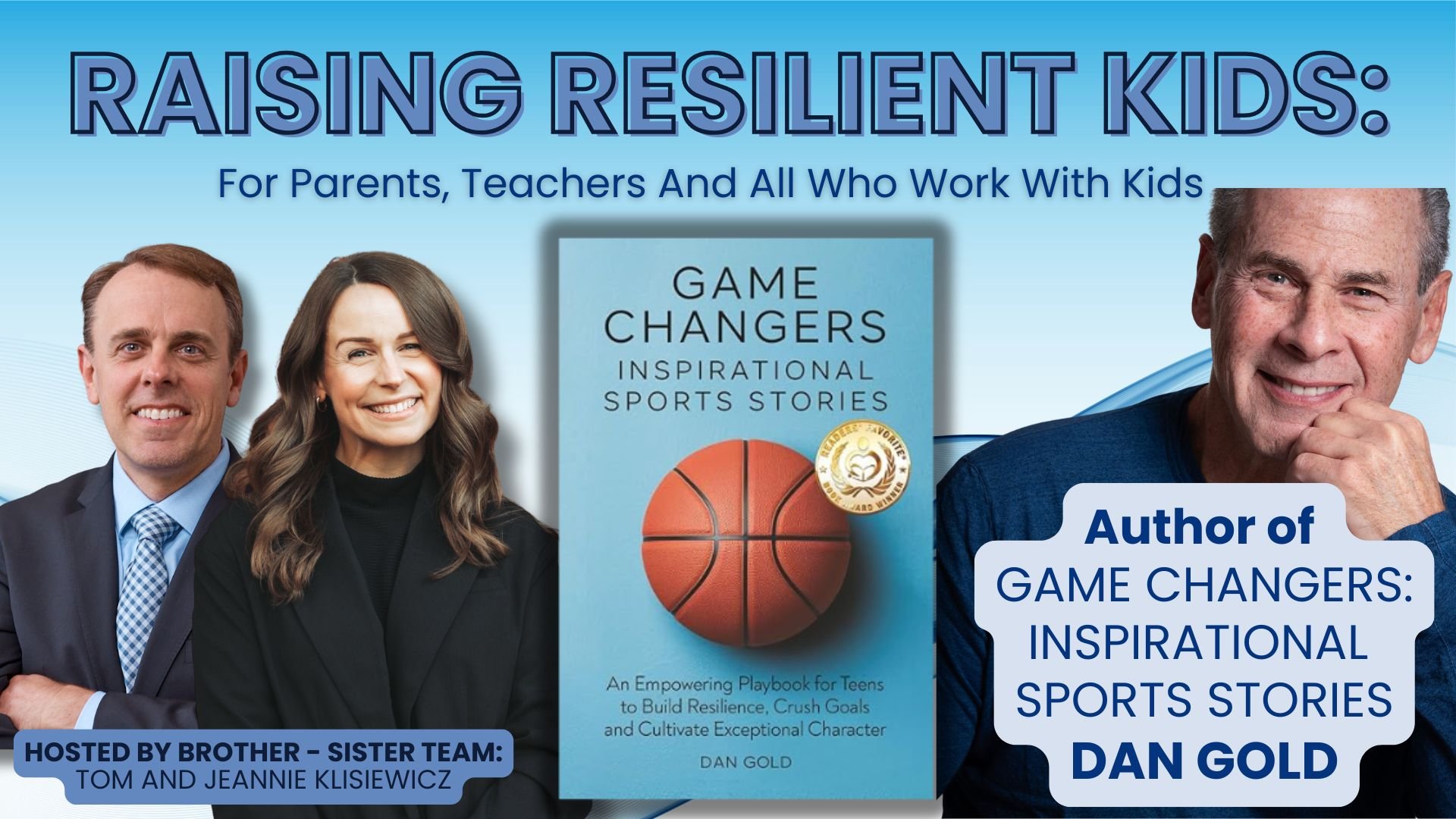
In this episode, Tom and Jeannie sit down with Dan Gold, award-winning author of the Game Changers series — books that use true stories of famous athletes and coaches to teach teens resilience, mental toughness, leadership, and character. Dan is a former surgeon, father of four, and lifelong sports fan who discovered that the lessons he learned on the field as a kid were the same ones that carried him through medical school, residency, and years in the operating room.
In this conversation, you'll discover:
Why Simone Biles represents a complete picture of resilience — across three distinct, life-defining moments
The Andre Agassi story: a cautionary tale for parents about the real cost of pushing kids toward goals that aren't their own
How Tom Brady was passed over 198 times before being drafted — and why the most powerful comeback is often invisible until it isn't
Three teachable mental skills — visualization, mindfulness, and positive self-talk — that elite athletes use and your kid can develop too
How the Game Changers books are structured to spark real conversations between parents and teens without lecturing
Why teens ages 13–17 are actually hungry for nuanced, complex stories — and how to use that developmental readiness to your advantage
Dan's books are available on Amazon:
Visit Dan's website: www.gamechangerstories.com
ABOUT DAN GOLD
Dan Gold is a lifelong sports fan, father of four, former surgeon, and storyteller who believes the lessons learned through sports mirror the lessons that matter most in life. As a dad and youth coach, he saw firsthand how sports shape young people into stronger, more grounded individuals. That belief is at the heart of his award-winning Game Changers series, which shares true stories of athletes and coaches whose lives remind readers that real success is measured not by wins, but by effort, resilience, integrity, and heart. His debut, Game Changers: Inspirational Sports Stories, earned a 2025 Reader's Favorite Gold Medal and continues to inspire teens, parents, and coaches alike.
THANK YOU!
Thank you for listening to the Raising Resilient Kids Podcast! We are siblings on a mission to help kids become their strongest selves. Each episode, we share proven strategies with parents, teachers, and all who work with youth and teens to build resilient, confident kids who can tackle life's challenges and thrive.
For more information on the podcast, or if you have a question you would like answered by one of our expert guests, please visit us at –
https://www.smarthwp.com/raisingresilientkidspodcast.
SPECIAL THANKS TO OUR SPONSORS
Episode Transcript
Tom: [00:00:00] What if the best resilience lessons for your teen aren't coming from you? They're coming from their sports heroes? In this episode, author and former surgeon, Dan Gold walks us through why athletes like Simone Biles, Tom Brady and Andre Agassi are the ultimate resilience teachers.
Also, how to use his book Game Changers to spark real conversations with your teen and three mental skills every young person can learn and practice to perform better under pressure. I'm Tom..
Jeannie: And I'm Jeannie. We are siblings on a mission to help kids become their strongest selves. Each episode we share proven strategies with parents, teachers, and all who work with youth and teens to build resilient, confident kids who can tackle life's challenges and thrive. Welcome to the Raising Resilient Kids podcast.
Tom: Jeannie, so, you know, um, the Mind of a Champion program that you kinda helped me with. One of the things that I always do with the kids that go through it with me is I always have them go back and learn about their heroes and learn the stories behind their heroes and [00:01:00] learn the resilience that they had to build up and learn about their failures and everything like that.
And it's a really good lesson that, that they always take home from, from that class. And then I came across a fantastic book, it's called Game Changers Inspirational Sports Stories and Empowering Playbook for Teens to Build Resilience, Crush Goals and Cultivate Exceptional Character.
I thought it was a fantastic book. 'Cause there's so many lessons about all these different athletes and their stories and, and the resilience and, and the troubles and the, and the things that they went through.
And I am psyched because we have the author Dan Gold on the podcast!
Jeannie: That's fabulous!
Tom: Dan, thanks so much for being there.
Dan Gold: Pleasure, pleasure.
Tom: Um, let me give you Dan's bio. So Dan Gold is a lifelong sports fan, father of four, former surgeon and storyteller, and that came across clear in the book. Who believes the lessons learned through sports mirror lessons that matter most in life.
As a dad and youth coach, he saw firsthand how sports shape young people into stronger, [00:02:00] more grounded individuals. And that belief is at the heart of his award-winning Game Changer series, so there's more than one book. Which shares true stories of athletes and coaches whose lives remind readers that real success is measured not by wins, but by effort, resilience, integrity and heart. His debut, this Game Changers Inspirational Sports Stories earned a 2025 reader's favorite gold medal and continues to inspire teens, parents and coaches alike.
Jeannie: That's awesome!
Tom: Dan thank you. Yeah. Welcome to the podcast.
Jeannie: Before we even kick off, I gotta ask Dan this, 'cause you the, the bio led off with being a sports fan. So Dan, what is your favorite sport to watch and your favorite sport to maybe play? And then who's your team that you root for the most?
Dan Gold: Hmm. That's easy. My favorite sport in the world is baseball.
Jeannie: Yes, me too.
Dan Gold: My favorite sport growing up was baseball,
Jeannie: Oh, okay.
Dan Gold: And I grew up in Cleveland,
Jeannie: Uh huh.
Dan Gold: so I grew up loving what was the Cleveland Indians and is now the [00:03:00] Cleveland Guardians. Still a change I'm having a hard time accepting, but, yeah, it's in my blood.
Jeannie: When I now, but I, I don't wanna take you back to 2016, but now is probably not the right time to tell you that we're both Cubs fans, right?
Dan Gold: Yeah. That's okay.
Listen, if you're gonna talk about losing in baseball in Cleveland, like you're in my heartland there, no problem. I can deal, I could deal with it.
Tom: Excellent. Well, Dan, let's, let's talk about the book. So, you know, obviously this is all, this podcast is all about building resilience in youth and teens. I heard so many different, I read so many different stories. Is there one story from the book, maybe an example that you think best demonstrates resilience?
Dan Gold: Well, uh, they all do. But if I have to pick one that that really works for me I would pick Simone Biles. I think Simone is great because her story tells multiple, stories of resilience and that's why she's kind of useful.
Her first great example to me of resilience is before she ever was a gymnast, you know, she grew up, uh, [00:04:00] a very unstable environment, was put in foster care as a kid, was eventually adopted by her grandparents. A very tough beginning, but rather than being defined by that very tough beginning, that's what she used as sort of her springboard to decide to become the gymnast.
A second great example that she provides of resilience, that's a bit more difficult than the subject, um, but still important as she was one of the survivors of Larry Nassar, the USA gymnastics doctor who abused hundreds of young athletes over the decades. And she did not have to speak up about that. And she chose to speak about it publicly, fiercely without apology because she knew that younger gymnasts needed somebody like her to stand up and sort of lead the way.
And then moreover, with Simone, there's the story of Tokyo where many of us will remember she withdrew from the finals in the biggest competition of her life for personal mental health reasons, and a lot of people called her a quitter.
She held her ground. She had displayed remarkable composure. She went on to cheer her teammates from [00:05:00] the sidelines and there were like three rough years of public judgment. And then she comes back from that in Paris next Olympics delivers some of the most remarkable, breathtaking gymnastics anyone had ever seen, and got four medals.
I think for parents, coaches, your audience, this person didn't demonstrate resilience once she demonstrated kind of over and over and in completely different ways, and that is such a robust picture of what resilience can look like all in one person.
Tom: Was there, was there a certain moment or experience that you had that made you realize, all right, I need to write this book that, you know, teach kids these lessons within the lens of sports?
Dan Gold: The book grew organically. This was not the result of some master plan. I grew up in the Midwest and I, I, I played football. I wrestled and played baseball, and I wasn't a star. I was a good athlete.
I wasn't a superb one, but I was a solid, hardworking kid. I loved playing and I loved competing. I was normal. But I realized that sports taught me [00:06:00] lessons that kept popping up later in life. How to handle pressure, how to fall, how to fail and show up anyway, how to be a good member of a team, how to be part of something bigger than myself.
And, uh, you know, I'm a, I'm a doctor or surgeon. As I went through medical school, surgery, residency, years in the operating room, all pretty challenging stuff. I kept tracing my personal ability to perform under pressure directly back to what I had learned as a kid on the field in the wrestling rooms, and it wasn't an accident. I realized that though I thought I was just having fun. This was training for real life by failing, succeeding, learning to be a team member.
And then when I became a dad and I got to watch it all over again through a completely different set of eyes. I started jotting some stuff down, some notes really about what I was seeing and what seemed to be working, what I was noticing, and what the sports experience were teaching my kids about life. So it started as something personal and I sort of planned on [00:07:00] these being sort of, you know, love notes for my kids.
And then I realized soon that, well, this stuff doesn't just, it's not just working for my kids. This applies to every kid.
Tom: One of the things that I really liked about your book was the structure of it. You've got, you know, after each of the, each of the chapters, you've got the reflection section, then you've got the action plan.
So if, if you know one of our audience members, parent a coach, they get this book for their teen, what advice would you give the teen on how to get the most out of the book?
Dan Gold: Yeah. Well, as you said that I, I put a little bit of thought into it. You know, I, I was trying to think what do I want to do here? And number one, number two thing, one, I want to entertain. This has gotta be fun. And number two, I do not want to lecture 'cause nobody wants to lecture, especially teens.
Jeannie: I was gonna say that especially teens.
Dan Gold: So, uh, the, so the chapters are aligned by sort of the concepts, like the chapters are on resilience, mental toughness, leadership, humility.
And then within each chapter [00:08:00] I picked six athletes and I picked them pretty carefully. So they represent a diverse spectrum of sports and sex and geography and time. Everybody can find something they can relate to. And then I, I paired the athletes, so there's kind of three pairs. And this sounds complicated, but it's not.
But the reason I paired them is, so the reader, the teens, the parents can see the same life lesson playing out in completely different contexts. So resilience looks one way in Simone Biles story, and it'll show up in a completely different way in Tom Brady's story.
And the pairing is intentional because I think when a teenager sees the same lesson lived out um, in completely different contexts, completely different sports. It stops feeling like a coincidence. It feels more like, hey, this is a principal that's worth paying attention to because I'm seeing the same stuff in these people that sort of look like they have nothing to do with each other. And I think that's kind of the fun of it, that the stories do the hard work here. So my first piece of advice is [00:09:00] I would read the stories. I would read them in the pairs. Just let 'em sink in. There's no lecture here. And then there's some reflective questions, you know, that's kind of draw the stories together.
Hey, what are we seeing here? What are we learning here? Uh, and that's kind of a fun spring point, springboard point. For, let's say the parents and the teens. So the parent doesn't have to sit down and say, Johnny, here's what you're doing and here's why it's really irritating. Johnny's not gonna want to hear that.
But if they read these stories together and then dad or mom says, what'd you think about that? Like, here's what I thought, here's what I kind of got out of it. Or what did you get out of it? And I think there'll be this kind of common language. I hope that will be, and this is what I'm hearing back, that will be easier for parents and kids to sort of to get into it.
Tom: And now a word from our sponsors.
Jeannie: Is your young athlete struggling with nerves, lack of confidence, or getting stuck in their head during competition? Mind of a champion solves this. This program gives kids a mental toolkit to [00:10:00] stay focused under pressure, bounce back from mistakes, and perform their best. These aren't just sports skills their life skills. Check out the link in the show notes for more information.
Back to the podcast.
Tom: I love that idea about, you know, sharing it, reading it with your, your child. I know just from when my kids were growing up though, if I told them, hey, I'm gonna read, you know, a hundred, 200 page book to you, they would, they'd be like, they'll back off, dad. What if I always found it best if I could just give 'em a little taste, like a little teaser to kind of, hey, this is what the book's all about, to kind of capture their attention.
Is there one story from the book that you'd suggest a parent kind of start with that and, and why would, would you choose that story?
Dan Gold: I would say maybe Andre Agassi's story, uh, and it's a great one for parents and coaches because I think that story speaks directly to something parents and coaches are sort of dealing with every day.
Andre Agassi grew up in Las Vegas. His father was obsessed with tennis, and he was obsessed with the idea of making his kid a tennis [00:11:00] champ, and he built a ball machine himself called the Dragon, and he essentially forced Andre to hit thousands of balls every day.
He never asked Andre whether he loved playing tennis or not, and in fact, Andre didn't love playing tennis. And he resented it deeply. And when he won Wimbledon, he describes in his book Open that he felt completely empty standing there holding the trophy. A remarkable and very honest thing for, for a young kid to admit.
And he sort of internally collapsed. His ranking tanked. His personal life fell apart. He hit rock bottom. He admits becoming a drug addict and this turnaround as he describes his personal turnaround, as he describes in his book, came when he came to this realization, I've gotta stop playing tennis for my dad and I've gotta see if I have joy in it myself. And his new coach, Brad Gilbert and his new wife, Steffy Graff, helped him discover the joy that he might or might not have for tennis on his own. And then he came back and unbelievable comeback [00:12:00] story, won the career Grand Slam ended up being number one when he retired at age 33. the lesson for teenagers is powerful and simple. You have to find your own reason to do anything in life. And nobody else's reason is ever gonna be enough to carry you through the parts, the hard parts that will inevitably come.
And I think for parents and coaches, the message is, it's important that your head's on straight, that you're consciously parenting and not just assuming that what you think is best is going to be what serves your child the most.
Tom: A great lesson for for parents
Jeannie: I would say a great lesson for both on both sides.
Tom: One of the things that, that I found kinda interesting is there were some kind of questionable athletes you had in there. They had that faced some public controversy. So I was curious why, you know, why you chose to include their stories in there and what, what you think that means for teens?
Dan Gold: great, great, great question. And it's the one I would ask me too. I had a couple friends of mine read that and like, why would you put that guy in there, you
Tom: [00:13:00] Yeah.
Dan Gold: A good friend of mine is a high school teacher in, in, in urban New York City, and he gave me some early feedback on the book.
His students are like 13 to 17 and he told me. Kids at that age are actively looking for nuance. They, they are trying to move beyond the black and white way of thinking as children. And they're ready to start exploring life's complexity it's messiness, it's imperfections. And when he said that I, something sounded really right about that.
We all know as adults, human beings are layered. No story about humans are ever about perfection, that success is rarely linear. And in fact, some of the most important lessons, like around accountability or redemption or personal growth, they simply can't be illustrated well through a clean, straight success story that you need the complicated ones to dig in on some of the more nuanced stuff.
I think teens are ready for these conversations and I think in many ways they're hungry for these kind of [00:14:00] conversations.
So I'm, I'm actually very proud of the more complicated parts of the book. 'cause I, I think, I think we, we need to take teens as people seriously and have those conversations if they're ready for them.
Tom: One of the things, one of the things that we talk about a lot in this is, you know, the mental training components of, you know, athletes or musicians or just, you know, people, people in general. And this came up a lot in, in the book as, as I was reading through, through the book, um, were there certain, as you were, you know, researching all of these athletes, certain techniques or strategies that kept coming up more consistently, whether that's, you know, we talk about mindfulness, visualization, those, those different techniques?
Dan Gold: Yeah, there were. And uh, I think there are probably three of them. Uh, you named two, uh, visualization and mindfulness. And I would also add to that list positive self-talk. The first thing I'll say is I think the reason it's worth stopping and addressing this, and I'm glad you asked a question that, that these aren't inherited skills these are teachable [00:15:00] skills. You know, visualization. I mean, Michael Jordan famously rehearsed every critical moment in his mind before it happened. Big shots, crucial plays. And the research on this stuff is actually extremely strong. That the brain processes a vividly imagined experience in a remarkably similar way to the real experience, meaning you can actually rehearse confidence.
Mindfulness, you know, learning to stay present, to stay in the moment, rather than getting pulled into anxiety, worried about outcomes, or being focused on poor past performances. And the ability to stay in the moment, especially under pressure is probably, I would say the single most valuable mental skill a young athlete can develop and that ability to stay focused on the moment transfers to taking a test, to public speaking to a job interview, to everything.
Jeannie: Mm-hmm.
Dan Gold: And then, uh, positive self-taught, uh, self-talk. I mentioned, um, athletes in the book, [00:16:00] Novak Djokovich, Alison Felix. They both spoke extensively about this internal dialogue that they deliberately cultivated.
Essentially coaching themselves through tough moments rather than catastrophizing. And what we say to ourselves under pressure matters enormously. And the good news for parents and coaches, all of these skills can be introduced. They can be practiced, and they can be developed. They're not innate. It's not a matter, do you have it or not.
It's like a muscle. You can exercise it and get better at it.
Tom: On the other side, failure, so we talked a little bit about this, but failure, let's face it, failure is inevitable. We gotta get that through to our kids and there's nothing, there's nothing wrong with it at all. If you wanna become the best that you can become, you gotta get used to failure. Um, Is there maybe a story from the book you'd recommend?
Dan Gold: There's lots of them and there's lots of failure. And success is almost always in on the other side of failure when you look at human stories, almost always. I think a really good one and a relatable [00:17:00] one for a lot of kids today is Tom Brady. Uh, Tom Brady. You know, Tom Brady's a kid who was passed over. Think about this. He was passed over by every single NFL team in the draft. Not once, not twice. 198 times before he got picked. Right? He failed over and over and over and over before he even got started playing, right?
And they finally take a chance on this kid in the sixth round and he was told right from the beginning, by everybody, you're too slow, you're too weak. You don't have the arm.
And I think what makes the, um, the Brady story particularly valuable for a teenager who just failed at something is that Brady's success was not built on one dramatic comeback moment.
His comeback was thousands of mornings showing up early at practice, working, improving, deciding he was gonna show that everybody was wrong. He just refused to accept other people's verdict on what his ceiling was, and his [00:18:00] comeback was invisible right up until the time that it wasn't.
I think showing them something like the Tom Brady chapter or one like it where the story does the talking where you see like how did he respond? He just responded by going back to work tomorrow and deciding he was not gonna give in and over time that wins.
Tom: Well, Dan, if people want to grab the book, where can they connect with you? Where can they get this book? As well as the other books, as well as the new book you got coming out.
Dan Gold: Yeah. Yeah. Um, well, everything's on Amazon and honestly, right. If Amazon doesn't sell it, then you probably don't need it because,
Jeannie: That's so true. That needs to be their new slogan. You should do that on the side too.
Dan Gold: Right. So, the, the book is Game Changers Inspirational Sports Stories. You held it up. It's a, you know, it's a, the blue book with the basketball in the front, and it's, it's, it's all over Amazon.
The second book is, um. I wrote it right afterwards. It's the same thing, but with coaches because there's just so many cool coaches. So I just sort of [00:19:00] made another one that one focused a little more on leadership and identifying what's great in a leader. What do I want to be, if I want to be a leader, how do I establish a legacy now even though I'm just a kid? And then, uh, we have a website, uh, just went up 'cause this whole thing is pretty new.
Uh, http://www.gamechangerstories.com. And that's kind of a home for this movement. And there's a thing in there about me and there's a thing about the books and where to get 'em. And then talking about the next book. And then we have a couple cool sections in there. One of 'em is a, a coaches area, which we're sort of looking at coaches, high school, college, and pro coaches who do amazing things who may not get the credit that they're, that they're due.
And I'll just mention that the, the new book is the same kind of thing again, but it's a daily reader. It's 365, one per day. Little stories of a sports story, the lesson, and then, Hey, what can I do with this today, this lesson today.
Tom: Dan, anything else, any final thoughts, advice, suggestions [00:20:00] for all the parents, the teachers, coaches out there that are listening?
Dan Gold: Well, nothing they don't already know. You guys got the most important job on the planet and uh, and we're all motivated. All of us parents and all of us who love kids, we're all motivated and from invaded from a place of love. But I would say do it consciously. You know? Um, make sure that our own egos, as fallible human beings, we try to keep that out of the equation.
That we don't focus on the trophies, that we honor the effort. We honor the spirit. We honor the kindness and the heart. That's what makes real winners.
Jeannie: Dan, this has just been so awesome. It has been so, so cool talking to you and here, and I can't believe that this was just something that you did. I, I don't know, in between being a father, a surgeon, then all of a sudden you're like, oh, I'll also be an author too. But you can see your passion for it.
And just thank you so much for the conversation
Dan Gold: Well, thank you. Thank you guys.
Tom: Jeannie, another great conversation. Lots of good stuff there. What was your main takeaway?
Jeannie: [00:21:00] My biggest takeaway was the fact that Dan went through medical school, residency he, he was a surgeon through his whole life he found himself reflecting back on lessons that he learned when he was a youth in sports.
It shows how powerful those lessons were, are how you carry them through your entire life. And then the fact that he put together a book of these stories of these famous athletes, names that we all know, and how they essentially are doing the same thing, how important these stories really, really are.
What, what about you? What were some of your takeaways?
Tom: I would agree. I, I think what I liked about it, and I talked about it a little bit earlier, just the way the book's structured and, and the fact that there's so many different athletes from so many different sports.
I'm planning on using it in the, the Mind of a Champion program. So people, they go through the, the online program, but sometimes I do one, if they want more, they'll, I'll kind of do one-on-one coaching with them.
And my plan is to, for some of the longer, [00:22:00] coaching sessions that I've got. Buying the book, giving it to, to the kid. And that way, no matter what sport they're in there, there's gonna be somebody in there likely from that sport because he's so many different athletes and the way it was structured, the way he has those reflection questions, action plan, it makes it so easy for myself or for a parent or for a coach to maybe, you know, read a story or two with the kids and then use those questions.
He's already got 'em there for you in book to be able to kind of talk through some of this stuff and how would it apply to you and what, what can you take this and, you know, how can you run with this knowledge going forward In your sports career? But like you said, then throughout whatever it is you decide to do with the rest of your life, whether that's to become a doctor or a lawyer, or a teacher, or whatever it may be, um, these, these lessons that you learn, you will continue to use forever and ever and ever. So I thought another, another fantastic conversation.
Jeannie: I could not agree with you more. I, I love talking with Dan. Dan, thank you so much for being a guest on the podcast. Be sure to check out his [00:23:00] book. All the links are below or in the show notes, and thank you so much again to all of you for listening. We will see you next month.