Fun, Zero-Prep SEL for Every Elementary Classroom: The Power of the Puppet
Check out the podcast on…



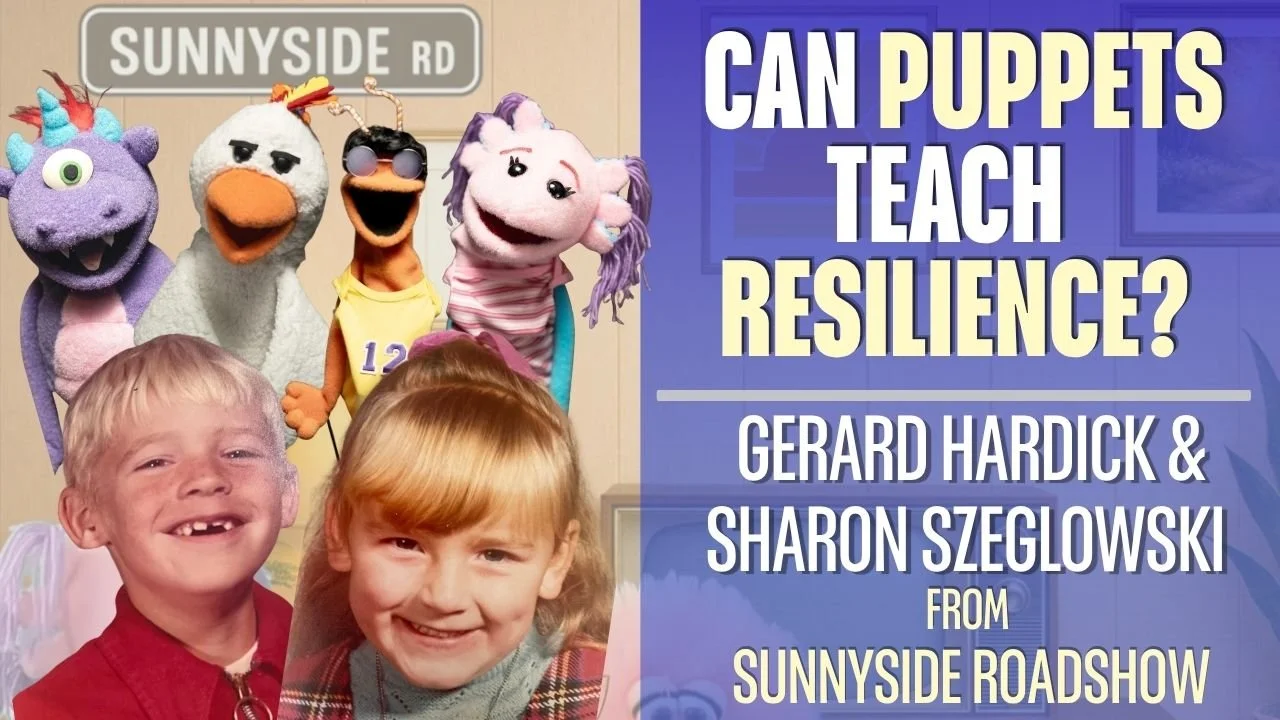
Every morning in classrooms across the country, kids are starting their day with puppets instead of the usual boring morning announcements, and loving it. Tom and Jeannie talk with Gerard Hardick and Sharon Andrews Szeglowski of The Sunnyside Roadshow, a social-emotional learning (SEL) program built around five-minute daily videos and a one-page teacher guide that takes zero prep.
In this episode:
How the program works: a short daily video, then a morning meeting discussion
Why kids find it easier to talk about a puppet’s feelings than their own
What’s inside the teacher guide: discussion questions, journaling and art activities, and a “test drive” section
How the show teaches resilience, empathy, and friendship without a formal lesson
How the program is built on five core Social-Emotional Learning (SEL) competencies: self-awareness, self-management, social awareness, relationships, and responsible decision-making
Why belonging and understanding who you are come before bouncing back
Special offer for our listeners: Mention “Tom and Jeannie” when you contact The Sunnyside Roadshow and they will give you a full season, teacher guides included, free for your classroom, school, or entire building!
Learn more: https://www.sunnysideroadshow.com/
Gerard and Sharon’s Bio
Gerard Hardick is the Cofounder, President and CEO of Sunnyside Roadshow. Gerard has been an elementary school educator for 28 years and has worked with kids in various capacities for over 30 — as a coach, summer program developer, and drama and dance program facilitator.
Sharon Andrews Szeglowski the Senior Manager of Curriculum at Sunnyside Roadshow. Sharon has been an educator for 33 years, serving as a classroom teacher, Department Chair, and a ten-year School Board Member and President. She's a published author in educational curriculum, has presented at state and local conferences, served on the New York State Commissioner of Education's Advisory Panel on Civic Education, and has consulted for numerous school districts.
Thank you!
Thank you for listening to the Raising Resilient Kids Podcast! We are siblings on a mission to help kids become their strongest selves. Each episode, we share proven strategies with parents, teachers, and all who work with youth and teens to build resilient, confident kids who can tackle life's challenges and thrive.
For more information on the podcast, or if you have a question you would like answered by one of our expert guests, please visit us at –
https://www.smarthwp.com/raisingresilientkidspodcast.
Special Thanks to Our Sponsors
Episode Trascript
Jeannie Klisiewicz Stathis: [00:00:00] Every morning in elementary school classrooms across the country, kids are starting their day with puppets instead of the usual boring morning announcements, and they are loving it. Today's guests have built a social-emotional learning program around five-minute, fun, engaging daily videos and a one-page teacher guide that takes zero prep, and it's sparking real conversations about feelings, friendships, and bouncing back.
I'm Jeanie.
Tom Klisiewicz: And I'm Tom. We are siblings on a mission to help kids become their strongest selves. Each [00:00:30] episode, we share proven strategies with parents, teachers, and all who work with youth and teens to build resilient, confident kids who can tackle life's challenges and thrive. Welcome to the Raising Resilient Kids podcast.
Jeannie Klisiewicz Stathis: We are so excited about this conversation today. We have two guests with us, and they are teaching resiliency and social-emotional learning to kids in a different way than any other guests we have had on the podcast over four seasons. And I think when we got an email from them and learned about them, the [00:01:00] word that came to me is nostalgia, which I think is like the best word of all. And I'm gonna let them explain more, but let me go ahead and tell you about the two guests. So first is Gerard Hardick. He's the co-founder, president, and CEO of Sunnyside Roadshow. Gerard has been an elementary school educator for 28 years, and has worked with kids in various capacities for over 30 as a coach, summer program developer, and drama and dance facilitator.
We also have Sharon Andrews Szeglowski with us. She is the senior manager of curriculum at Sunnyside [00:01:30] Roadshow. Sharon has been an educator for 33 years, serving as a classroom teacher, department chair, and a 10-year school board member and president. She's a published author in educational curriculum, has presented at state and local conferences, served on the New York State Commissioner of Education's advisory panel on civic education, and has consulted for numerous school districts.
Welcome, Gerard and Sharon.
Tom Klisiewicz: Welcome.
Jeannie Klisiewicz Stathis: We love your shirts. We love the shirts.
Gerard Hardick: Oh, thank you very much.
Jeannie Klisiewicz Stathis: This is, like, where I can, like, get a little bit of that [00:02:00] nostalgia in there.
Gerard Hardick: This is the dorkiest shirt I've ever had, but I love it. Couple of our characters.
Jeannie Klisiewicz Stathis: So will you two please tell us and tell our audience what is the Sunnyside Roadshow and who is it for?
Gerard Hardick: Like you said, Sunnyside Roadshow is a social-emotional learning program. It is essentially daily morning video announcements for classrooms, so this is for elementary classrooms and teachers. Our episodes are about five minutes long, four or five minutes long, but where they really take on meaning is [00:02:30] with what Sharon does.
Um, based on our characters, which are mostly puppets, we have one human character.
Gerard Hardick: Based on our characters' behavior and the way they act, Sharon writes connections to social-emotional learning topics that the teachers can use. So the kids, and it's usually first thing in the morning, the kids will watch the video while the teacher's taking care of attendance and lunch count things like that. Then they'll have their morning meeting on the rug, and they can say things like, "Hey, why do you think Polly was so anxious today? How could we tell she was anxious?" Or, [00:03:00] "What made Walter so upset this morning?" When, and I have to tell you this, I write the scripts for the program, and I, I, I always have a goal in mind, but the first time that Sharon wrote her kind of curricular work it brought tears to my eyes.
It gave meaning to what I was hoping to happen.
She just gets it so well that she takes my kind of creative flair and storytelling and she gives it meaning that is literally [00:03:30] life-changing for kids, so.
Jeannie Klisiewicz Stathis: What is the origin story? Where did Sunnyside Roadshow come from?
Gerard Hardick: Sunnyside started really, uh, during COVID.
Uh, our school where Sharon and I taught, um, has a beautiful morning program. Every Friday the whole school goes to the gym, they celebrate birthdays, we sing songs, announcements. And the principal at the time said, "Hey, everybody's home now. Is there anything you can do online to sort of help us with the morning program feel?"
So I did, and literally I had, I swear this is [00:04:00] true, I had a puppet in, in a bin in the basement that I had never used. And I was like, "Man, the kids'll rather look at this guy than me," so I put him up, and we mimicked our morning program, and it really sort of just took off as a very popular thing for... We could have a shared experience from our own homes a little bit.
Um, after that some people asked if I would do, um, remote birthday parties with this puppet, so I did that.
Those, those ended [00:04:30] up bopping around the country because kids from everywhere could be there.
But then it all just kind of died down, but it never left.
Like, you couldn't deny the reaction that kids were having. And then that's when I thought there is a way to reach more kids. So then I started bringing this up to Sharon, and Sharon was like, "Oh man, we can do this." And we thought about, uh, the most important thing that we feel, which is the social-emotional component, and we just put this together.
And, um, we're just super [00:05:00] happy with the way it's turned out.
Tom Klisiewicz:That shocks me, 'cause they're so well done. I just figured you had... that was, like, a hobby of yours, was, like, the, the puppetry and stuff, that the fact- Uh ... that that just kinda started just from COVID.
Gerard Hardick: Tom, I'm not a puppet guy.
Tom Klisiewicz: No?
Gerard Hardick: I own, I own a puppet company.
Tom,
Tom Klisiewicz: No offense to puppets, there’s nothing wrong with puppet people
Gerard Hardick: I play with puppets all day, but I'm not a puppet guy
Gerard Hardick: No, this was just out of necessity. It just kind of came up. It just happened.
Jeannie Klisiewicz Stathis: So tell, you know, our audience, what are some of like [00:05:30] the social emotional skills that kids will learn from these videos?
Sharon Andrews Szeglowski: We're, we are research-based. We are based on CASEL Learning's five principles. So we're based on self-awareness and understanding their feelings, and self-management, what to do with those feelings, social awareness, so of the people around you and what they're feeling, and building relationships with those people, friendships, and making good decisions in your life.
But basically, I always tell people it's about being a good human, right? It's about being a good [00:06:00] person. It's about how to be a kind friend, how to handle it when maybe something, someone's not kind to you or you have a big feeling and what to do with it. So it's really why it resonates with us, this idea, the resiliency idea.
You know, we're teaching resiliency and being able to manage, you know, the ups and downs and the things that come our way, and growing up is just not easy. You know, so one of the, one of the letters we got from one of the kids said, "Thank you for teaching me how to be nice to people even when they're mean to me."
That's, that's [00:06:30] what we're teaching. That's our curriculum, is what do you do when these things happen?
Jeannie Klisiewicz Stathis: Yeah, absolutely. And I just think the, the way that you do it, you know, Tom is also big into like, you know, these resiliency techniques and teaching skills, and we have talked to teachers that he works with that will pop him up on the screen, and they say like, "Oh, it's so nice for our students to see someone other than, you know, my face," being the teachers.
This takes it to a different level, where like now you have these like cute, adorable, fun puppets. I just feel like it has to resonate so [00:07:00] much, especially with these, these younger students.
Tom Klisiewicz: So you're saying I'm not cute and adorable, Jeannie?
Jeannie Klisiewicz Stathis: Sorry, Tom. No, you're my brother.
Gerard Hardick: In a different way, Tom. In a different way.
What we do, 90% of what we do is indirect learning, right? So our characters are not saying, "Hey, how can we show empathy?" Or, "How could you have..." Our characters are just acting the way they act. They are who they are, and they are beautifully flawed characters just like we are, right?
Um, so it's when Sharon's work is in the hand [00:07:30] of the teachers, that's where the real learning happens. And since this is a basically a K to 5 program, since we don't know every kid in every classroom, once our stuff is in the teacher's hands, she can dedicate it towards her kids, what those kids need- How to ask those questions, how to draw the kids out a little bit.
Our characters have what we hope to be relatable characteristics, right? We have a, a character who we... Their backstories. We know he was, uh, brought up in foster care, [00:08:00] so around the holidays he struggles a little bit. We have a character who struggles with anxiety. We have a selective mute character. And, um, we have a character, um, happens to be my character, he's just a knucklehead. He makes a lot of mistakes. He makes a lot of bad decisions. And I think what Sharon and I both learned in our own teaching is kids find it a lot easier to talk about other characters' feelings, other characters' life circumstances than they do their own. And then ideally their stuff comes out, too.[00:08:30]
Jeannie Klisiewicz Stathis: How about the lessons? How are these lessons structured? Maybe can you give us an example of one of them, you know, how it's covered in the episode?
Sharon Andrews Szeglowski: Well, we don't... You know, when we say how's the lesson structured, I think we aren't really structured like a lesson which I think is one of the things that makes us different.
We see the video is this five-minute shared experience. The teachers get a guide. It is a one-page teacher guide. It recaps the story so that it is no prep for them, but then there's the questions that are really the meat of [00:09:00] it. This, the discussion is the lesson. Classes can take different things from it.
There's obviously a focus that the storyline that, that Gerard has written will lead to, and the way the questions are written will pull certain things out, like, "Did you notice what Holly did today when she was feeling not so great about what was going on, and she was feeling nervous? Did you notice what her friends did? What did they do that would help her?"
I call it the power of the puppet, right? You ask about a puppet, how they might [00:09:30] feel and what else they could have done, and everybody's got an idea of how they could have handled it. But then sometimes, and as the year goes on, the kids do start to say, "Well, I felt like that," and, "I've experienced that."
The lessons are what they take away, and the curriculum kind of spirals. We're al- always hitting those same five skills in different ways.
So as the year goes on, obviously we have a curriculum map behind the scenes. Kids don't know that. The kids just think they're watching a great show and having great conversations.
[00:10:00] So they probably wouldn't say, "Oh, we had a lesson on this."
**********
Jeannie Klisiewicz Stathis: And now a word from our sponsors.
Tom Klisiewicz: Leverage your child's love of sports to build lifelong resilience skills. Let the Mind of a Champion program show you how. Check out the link in the show notes for more information.
Jeannie Klisiewicz Stathis: Back to the podcast
**********
Jeannie Klisiewicz Stathis: I was gonna say, it really is a, a wonderful conversation starter.
It gets these conversations going. And I know you mentioned how, like, which I love the fact that a teacher could be showing one of the episodes while they're taking attendance, and then they could [00:10:30] sit down, you know, at their morning meeting and, and talk about what they just saw. What are other ways that maybe they can incorporate that into their classrooms?
Sharon Andrews Szeglowski: We have heard that people find it very easy to implement, just the fact that it's 10 minutes. And because they can take the pieces and fit them into their existing structure.
Gerard Hardick: Sharon's teacher's guide also include extra actual hands-on activities. It's not just the conversations. So if, um, teachers have time or kids finish their work early, Sharon will [00:11:00] have a journaling activity, or maybe a- an art activity that will help express feelings with art.
So Sharon is underselling her, um, massive contribution here. And then not only that, probably the best part, one of the best parts is, um-
Sharon Andrews Szeglowski: My favorite part ...
Gerard Hardick: uh, exactly. She calls it the test drive section of the teacher's guide, and it's how can you apply what you saw today, what you learned today in your real life?
So if we're talking about being positive and helping friends [00:11:30] out, can you give a couple compliments today? Can you do something nice or something? So this, this single page of curriculum is the most meaningful piece of paper in education history. Like, it's that. It's, like, e- extremely important, and it just, it is all based on what the teacher can do in a day.
Jeannie Klisiewicz Stathis: How about a success story? Can you share a success story from a school or a classroom that might have benefited from, from Sunnyside Road Show?
Gerard Hardick: We send surveys out to, um, [00:12:00] teachers, and they pass things along to their kids.
Sharon, do you wanna tell us your favorite quote about reviews?
Sharon Andrews Szeglowski: Well, we always say that the best, best, best reviews and evaluations and feedback comes in crayon.
Because we, we get cards that kids have made. Pictures they've drawn. The beginning of the summer, there was a box of 100 cards from a school.
And they'd obviously done writing with it, and really put thought into these letters, because they were so beautifully written [00:12:30] that they just were, that they were just... And the pictures of the characters. It's all like everybody seems to have a favorite character.
Gerard Hardick: Probably one of my favorite things a teacher wrote to us is, "If we miss an episode. The kids demand that we watch it the next day.
And I wanna say this, Sharon probably didn't realize this until we talked about it this year. Every day, because of Sharon's teacher's guides, we are training teachers how to do this.
Like, we're literally giving them a script. And I know that in my teaching career, [00:13:00] I was horrible with technology, just awful, right? Every time we had a training, I'd go next door and say, "What are we supposed to do here? What are we doing?" A lot of folks are like that with social-emotional learning discussions, right?
And kids, kids are certainly like that in simply trying to understand their own emotions. Every single day, these teachers are being trained how to ask these questions, how to have these conversations, and, and how to include themselves in their conversations. Sharon's writing is so powerful for a teacher's [00:13:30] sense of ownership in their classroom, and it's even indirect for the teachers.
They don't know they're learning it. They just are.
Tom Klisiewicz: I talk to a lot of teachers out there, and the, you know, the biggest objections I get or obstacles that they face are, "Hey, I don't have enough time for this, and I don't understand this topic." So you've, you've solved that. It's only 10 minutes.
You know, pretty much- Well ... all the people we've had, the teachers we've talked to on this podcast say, "Yeah, I think 10 minutes is, is ideal. I, I could- I could fit that in." And then the fact that it's just one page, they don't have to read an entire book. They just, one page- [00:14:00] with, you're guiding them through it. That is fantastic.
Sharon Andrews Szeglowski: We never really have to convince people that there's a need for this. That, that seems to be general agreement. These are the major problems facing our schools and our kids today. Everybody understands the, the obstacles. There's the, there is no time. There's the financial obstacles.
So far, the feedback we're getting is that we're not running into those obstacles.
So the kids like it because it's fun. The teachers like it 'cause it's easy to implement for them and they don't have to do a lot of prep, and the kids [00:14:30] like it. And truthfully, administratively, it, it's, it's low cost. It's, it's research-based. Everybody's gotta have some SEL program for their- ESSER requirements and Tier 1 interventions. So it kind of, we were trying to hit a win-win-win, which was what we thought made us seem unique, and now we are starting to see and get that fee- get the crayon feedback that it's working.
Gerard Hardick: Any school that uses us, um, gets shout-outs from our characters. So if a classroom has met [00:15:00] a behavior goal or even a math goal, the teacher can say, "Mrs., Mrs. Samuelson's class needs a shout-out," and our characters will talk about those kids by first name, talk about that teacher.
We did one for one of our schools. They brought the whole fourth grade down to the auditorium, showed it on the big screen, and then sent us the kids jumping up and down in their seats about this. This year we got a ton of new schools, and we have two characters that travel. They're called the Ramblers.
We have a 19... Tom, you gotta [00:15:30] come and check it out. We have a 1959 Rambler in a garage that we cut the floor out of, and two of our characters can drive anywhere in this thing. For us-
Sharon Andrews Szeglowski: Even to other continents, apparently.
Gerard Hardick: Yeah, we can drive through the ocean. Don't worry about that. We'll talk about it later.
But that was a way to show, to show suburban kids what it might like be in a, uh, to be in a big city, for rural kids to see suburban areas. So, um, with those characters, um, cruising around, we go to the schools that we service, [00:16:00] and we'll be standing outside their front door. Our characters will say, "Here we are at, uh, you know, Johnson's, uh, Elementary School in Virginia, and we just gave their teacher a note."
And then the teacher will have a note that we sent them, and they'll share it with the. We're, some, some teachers will send us a picture of their classroom or their library, and our characters will be in their library.
Tom Klisiewicz: That's so cool.
Jeannie Klisiewicz Stathis: That is so smart, 'cause it's almost like the kids become famous. Like, they see their school [00:16:30] or they hear their teacher's name or their classroom. How impactful that has to be for them.
Gerard Hardick: It's very fun from a creative standpoint to do that. Um, and then it's just on Sharon to, to give it meaning educationally.
Jeannie Klisiewicz Stathis: All right, Sharon, thread that in.
Sharon Andrews Szeglowski: They are fun. I laugh a lot when I'm reading the. I can read the scripts and I'm, I'm laughing going, "Really?"
Jeannie Klisiewicz Stathis: Watching them, it really, I, I was laughing, and like I said, very nostalgic.
Gerard Hardick: Jeannie, I gotta tell you, that was very purposeful. If you look at a lot of newer [00:17:00] cartoons the last 20 years, those, those purposeful bright light flashes and scene changes and explosive stuff, that's to get kids to keep watching that screen.
We need them for five minutes, right? So we purposefully brought it back to subtle colors. Our background is paneling like my parents' basement, you know? And we do not mention technology on the show. Never even mention it. We can hit the topics that would surround things like [00:17:30] messaging and stuff like that that kids do have to deal with, but we don't have to do it using technology.
Jeannie Klisiewicz Stathis: So for, for somebody that's listening who's maybe interested in getting this into their classroom or into their school district, what should they do?
Sharon Andrews Szeglowski: Well, it's probably the easiest thing is just to go to our website, which is sunnysideroadshow.com. And they can see sample episodes, sample teacher guide.
They can see, uh, how to get in touch with us very easily.
Gerard Hardick: Anybody who mentions Tom and Jeannie, we will, and this is legitimate, we will [00:18:00] give them the season for free for their classroom, for their school, their entire building. We will give it to them for free with the teacher's guide, literally everything.
No financials will be exchanged. We just want this in the teachers' hands to show their kids.
Jeannie Klisiewicz Stathis: Well, that is very, so very kind for you guys to do. Thank you for our listeners. So you did hear that, Tom and Jeannie, and in that order, 'cause Tom is the older sibling
Any final maybe [00:18:30] suggestions or thoughts or advice that you have for the parents or the teachers or coaches or administrators that, that are listening?
Gerard Hardick: I have to tell you, I love the name of your show, right?
Like, helping kids to become resilient, and I thought about it all week, what would I define resiliency as? And it's essentially the, the ability to bounce back. In my estimation, you cannot bounce back unless you understand who you are. You cannot bounce back from social anxiety if you're [00:19:00] calling yourself a dummy for being so nervous.
If you can identify that feeling, you can then address that feeling. I grew up, I don't know about you guys, but I grew up, any social mistake, any issue, any conflict, I generally walked away thinking, "Why were you such an idiot?" And I would just keep walking, right?
Jeannie Klisiewicz Stathis: 100%, yep. Yeah.
Gerard Hardick: But if you can say, "Why were you so anxious?"
Or what could you have done to kinda help that anger that you reacted with? You have to be able to identify those things before [00:19:30] you can bounce back, then you can bounce back. Much of what we do is exactly what I think Tom's goal was with this podcast, was to teach people to bounce back by knowing who they are.
Jeannie Klisiewicz Stathis: So true. So true. Sharon, for, anything for you that you'd like to chime in with?
Sharon Andrews Szeglowski: I think it's just about building that culture in your classrooms. We need kids feeling that sense of belonging in school. We know the things that will impact social emotional learning. We know that if they feel they have trusted adults and that they're accepted and that they're in a [00:20:00] community that understands them, and we can build that.
Hopefully our road show is a great way to start that conversation classroom-wide and school-wide, but also it's about the people that are in that place. It's about the teachers building that com- that community in their classrooms. Because when the kids feel that way, we know you're not getting to math, science, social studies. Any of those things are not being learned unless you are coming with that feeling inside you.
So that's kind of my feeling of resiliency, is I have the support and the skills- [00:20:30] Are there people that will help me to persevere through this thing called growing up? And if we can help you, we'd love to, but there's many ways to do it. Talk with the kids. Enjoy the kids. Build relationships with them. That's my feeling.
Jeannie Klisiewicz Stathis: Sharon, Gerard, thank you so much for your time. We really appreciate it.
Gerard Hardick: Thank you so much for having us. This was the greatest. I appreciate it.
Tom Klisiewicz: All right, Jeanne, what'd you think of that one?
Jeannie Klisiewicz Stathis: Ugh. Again, I sound like a broken record. They're so great and you know, say it with me now, I want them to be my friend. [00:21:00] I think the thing that really stuck out to me was something that Sharon said, that I believe really summarizes what Sunnyside Roadshow is, which is they just wanna teach kids how to be a good human.
And isn't that what we're trying to do ourselves, and teach the kids in our lives? It's just so good. What about you, brother? What, what did you think?
Tom Klisiewicz: Yeah, kind of on that, on that same note, I was actually having a conversation with a friend of mine just a, a couple days ago, and he was just talking about, you know, that is there any hope for humanity these day - with AI, and politics and, and war and everything like that. [00:21:30] And, you know, he just was depressed. And basically I tell him, I'm like, "Listen, you need to listen to the podcast." Raising Resilient Kids podcast. 'Cause I'm like, you know, we just had on these two phenomenal people who are basically spending their free time creating these wonderful resources for, for kids, and trying to help them to become their best selves, help them with the social-emotional learning piece, all on their own time, just because they care. And we're just blessed to, you know, talk to people like that every single month. [00:22:00] And, and Gerard and Sharon were, were perfect examples of that.
I wanna thank them so much for offering this to listeners, you know, to get a season for free. That was, uh, you know, very generous of them.
Jeannie Klisiewicz Stathis: So generous.
Tom Klisiewicz: I'll be definitely sending this out to all the elementary school teachers I've worked with over the years and letting them know about this, so that, you know, they can, they can do this.
I mean, it, it just sounds like su- such a cool resource, interesting for the kids.
And we know teachers don't have much time, so the fact that they give them those [00:22:30] one-page guides that gives them you know, helps them kind of frame the conversation, gives them those activity ideas, and then that test drive piece. You know, how they can apply what they learned is just phenomenal.
So Gerard and Sharon thank you so much for being guests and for being who you are. You know, we're, we're, we're blessed and grateful to have spoken with you and for all the good that you're doing in the world.
Jeannie Klisiewicz Stathis: That is so true.
Please make sure that you check out Sunny Side Roadshow. Thanks again, Gerard and Sharon, and thank you to all of you for listening. We will see [00:23:00] you next month.
Tom Klisiewicz: The Raising Resilient Kids podcast is sponsored by Happy You're Here, educational, safe, and joyful videos for kids. Through music, visuals, and sound, your baby, toddler, and preschooler will learn about letters, numbers, and so much more.
Happy You're Here is quality screen time that both kiddos and their adults can feel good about. Head to www.youtube.com/@sohappyyouarehere to check it out or click on the link in the show notes.
Jeannie Klisiewicz Stathis: The Raising Resilient [00:23:30] Kids podcast is also sponsored by the Resilient Youth Program. If you're a parent, teacher, or school administrator who wants to incorporate a proven resiliency building program into your school's curriculum, then the Resilient Youth Teach the Teacher program is exactly what you need.
This curriculum brings coping skills and life management tools into the school environment to help students better manage daily stress and positively impact their academic performance, mental health, and wellbeing. For more information, visit the Resilient Youth Teach the Teacher website in the show notes [00:24:00] or at www.smarthwp.com/ry4teachers. That's www.smarthwp.com/ry4teachers.
The Raising Resilient Kids podcast is produced, hosted, and edited by brother and sister team Tom and Jeannie Klisiewicz. Do you have a question you would like answered by one of our expert guests? If so, visit [00:24:30] www.smarthwp.com/raisingresilientkidspodcast.
Thanks for listening.