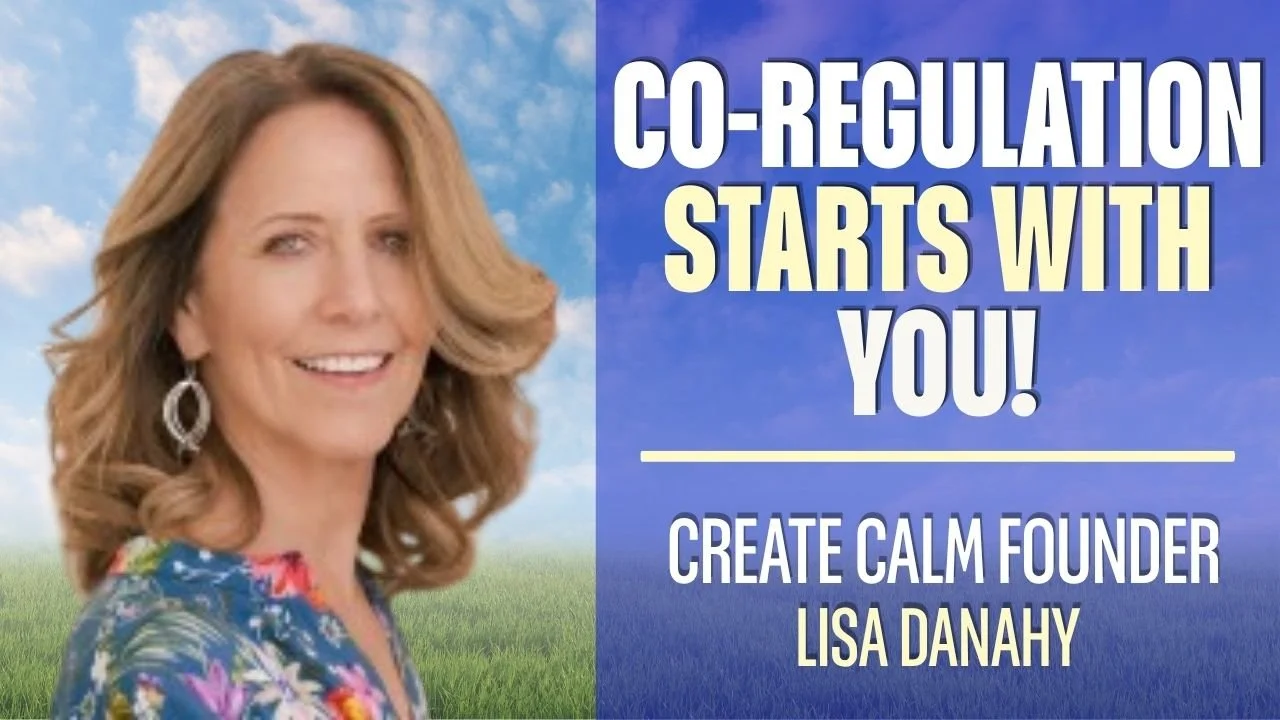
Breath, Movement, Belong: Simple Everyday Rituals for Resilient Kids with Lisa Danahy
Check out the podcast on…


In this episode, Tom and Jeannie sit down with Lisa Danehy — educator, yoga therapist, and founder of the nonprofit Create Calm — to talk about bringing calm and connection into schools and homes as the school year gets rolling.
Lisa, who has over 30 years of experience as a school administrator and SEL curriculum developer, shares practical rituals and routines teachers can use to build safety and stability into the school day, from grounding themselves before entering the classroom to using consistent breathing and movement cues during transitions. She dives into the concept of co-regulation — how a teacher's or parent's own nervous system state influences the kids around them.
Lisa also lead us through a hands-on breathing and movement exercise listeners can try at home or in the classroom as well as a short guided exercise you can use to reconnect with what brings you joy.
Lisa Dahahy Bio
Lisa Danahy is an educator, yoga therapist, and the founder of Create Calm, a non-profit that has brought specialized yoga and mindfulness programming to hundreds of schools and community organizations across the country.
Lisa holds a Master's in Yoga Therapy and a BA in Psychology, and brings over 30 years of experience as a school administrator and SEL curriculum developer. She specializes in helping neurodiverse, disabled, and underserved children and young adults — and in training educators, parents, and caregivers in practical tools for self-care and resilience.
She's also a Hay House featured author and has been a guest on dozens of podcasts and national conference stages.
For more information on Lisa and her programs please visit - www.CreateCalm.org
Thank you!
Thank you for listening to the Raising Resilient Kids Podcast! We are siblings on a mission to help kids become their strongest selves. Each episode, we share proven strategies with parents, teachers, and all who work with youth and teens to build resilient, confident kids who can tackle life's challenges and thrive.
For more information on the podcast, or if you have a question you would like answered by one of our expert guests, please visit us at –
https://www.smarthwp.com/raisingresilientkidspodcast.
Special Thanks to Our Sponsors
Episode Transcript
Tom: [00:00:00] Building a classroom culture where kids feel calm, connected, and ready to learn takes just a few intentional minutes a day. Today's guest has spent over 30 years helping schools do exactly that, using tools as simple as the breath and movement to shift how kids show up and how they treat each other.
I'm Tom.
Jeannie: And I'm Jeannie. We are siblings on a mission to help kids become their strongest selves. Each episode, we share proven strategies with parents, teachers, and all who work with youth and teens to build resilient, confident kids who can tackle life's challenges and thrive. Welcome to the Raising Resilient Kids podcast.
Tom: Jeannie, how are you?
Jeannie: I'm doing great, brother. How are you today?
Tom: I'm excellent, excellent, excellent. I am really excited for our guest today. She's got a ton of experience, like, working with schools, working with parents. You know, school's about a month in. Thought it'd be a great idea to kinda give some more information, some more tips, like we did last month, for, for our teachers, but also for parents at home and things like that.
Our guest today is Lisa Danahy. She's an educator, a yoga [00:01:00] therapist, and the founder of Create Calm, a nonprofit that has brought specialized yoga and mindfulness programming to hundreds of schools and community organizations across the country. Lisa holds a master's in yoga therapy and a BA in psychology, and brings over 30 years of experience as a school administrator and SEL curriculum developer.
She specializes in helping neurodiverse, disabled, and underserved children and young adults, somebody we really haven't talked about much. Yeah. That group we haven't talked about much, so- I think she'd be great for that. She's trained educators, parents, and caregivers in practical tools for self-care and resilience.
She's also a Hay House featured author. Yeah. And has been a guest on dozens of podcasts and at national conference stages. Lisa, thank you so much for being here.
Lisa: I am so excited to be here. You all are amazing, what you do, and I'm thrilled to have this conversation with you today.
Tom: Well, thank you. You're amazing at what you've done. With, with, you know, the fact you- that you've worked with, you know, hundreds of schools, thousands of educators out there- with a month or so into [00:02:00] the school year, what's your recommendation? What, what advice would you give teachers at this point of the school year?
Lisa: Take a breath. Right here, right now. Breathe in. Breathe out. You are here. You are okay. Um, and then beyond that, I think my, my advice is remember connection before instruction.
And the beginning of the school year is such a beautiful place to establish rituals and routines, to form some class agreements.
You know, how are we gonna conduct ourselves? How are we gonna regulate ourselves and support each other?
Jeannie: Sure.
Lisa: Um, and form that kind of personal connection and community connection so that we feel safe, that we feel like we can practice and be curious as learners. And for the teachers to be able to [00:03:00] tune into energy versus behavior.
This notion of less words, more movement. Um, you know, tuning in and pivoting instead of locking in and controlling.
Tom: You mentioned some rituals and routines. What are some that you'd recommend?
Lisa: Well, one of my favorite things is to start, uh, first of all, as a teacher, before I walk in the classroom, to feel my feet on the ground to take some breaths, to center myself, to let go of the stuff I brought to school with me.
Um, and then once I'm in the classroom, you know, at all ages, at some point during the day, there's some sort of group circle time or coming together.
And I think introducing some breathing exercises and some, um, movements that we do every day at the start of that group time or at the start of our academic times.
Lisa: um, and doing it consistently as [00:04:00] just part of our transitions. Every teacher talks about transitions are, are the, the worst, right?. Transitions are where we all fall apart because the kids are kind of unsteady and they're not sure. So if you can build some transition routines with movement and breath that make transitions predictable and safer feeling- then you're going to have a little bit more consistency and stability through the day.
And those rituals make it so that when we're in crisis or challenge- we can access those tools a little bit more consistently, 'cause they're part of our culture.
Jeannie: What I love about that, Lisa, that I think is really important and I wanna reemphasize, is how you started it with telling the teachers to take a quick moment for themselves before they walk into that classroom. Because it, it starts with them, you know? So they have to be at that centered place in order to be able to really be there and be present for, for their students. And I think that advice to just [00:05:00] take a breath before you kind of even walk in, feel your feet on the ground, it's grounding.
It's very powerful. It's great advice.
Tom: Yeah, and not just for teachers. No matter what you do for a living, you know, right? Before you transition into the workplace, back home, that's, that's great advice.
Lisa: I'm asked a lot about what to do in a classroom, um, but my, my comment is always, you know, what place, what environment isn't a classroom?
Where are we not- connecting and learning and wanting- to grow and-... and, right? And so every place is a classroom, so all of these techniques we're talking about today go everywhere. And, and I think, Jeannie, what you're talking about is this notion of co-regulation, and what I really want folks to understand is this isn't just one more thing that you have to do in your day.
This is about setting yourself up to feel safe, to feel regulated, to feel in control- but also to receive the [00:06:00] support of your students. So often we talk about this, you know, teacher sort of containing the space and teachers being the, the leaders of the experience. But no, it's a co-created experience.
So when I show up regulated, my students know that I'm ready and they support me. And I don't come in thinking I have to tell them what to do, I have to show them what to do I have to, I have to, I have to. It's what are we gonna create together today?
Tom: Lisa, do you have any other, like, co-regulation strategies you, you recommend?
Lisa: Yes. I have a whole book full of them. So co-regulation from a nervous system or a physiological standpoint is when I arrive in any situation, in any environment, I show up with my nervous system in some state. And I have within my nervous system something called mirror neurons, and mirror [00:07:00] neurons want to look at what's happening in the environment and help me belong, help me feel connected. So my mirror neurons walk into a room with me and go, "Are we aligned? Are we doing the same thing?" And if I walk into a room of really stressed out- anxious people, my mirror neurons are going, "Hey, girl, you better get stressed out. You better get anxious."
Jeannie: Sure.
Lisa: But if I walk in pretty regulated, then what happens is their mirror neurons go, "Ooh. Ooh, let's, let's match that. That feels really good." So, so we're talking about energy, right? We're talking about this really subtle space of what do I feel? Do I feel a lot of bigness? Do I feel a lot of littleness?
And bigness, I wanna be clear, there is no good or bad here. There is no you know, better being big or little energy, because [00:08:00] it's all about being able to move it. So what I wanna do is I wanna notice my energy levels, and I wanna notice your energy levels. I don't even need to label them. I just go, "Oh, I'm feeling like there's a lot of bigness out there."
And then in that moment, I can make this discernment by connecting with my breath. I can discern whether I wanna match that energy or I want it to match me. Whether I wanna go up or down. So this notion of co-regulation, especially as a teacher or a parent, is this idea that in taking a conscious breath, and we'll do one in a moment, in taking a conscious breath, I say, "Oh, am I balanced? Am I grounded? Am I going to match their energy or am I gonna invite them to m- match mine?" So it's about reading the energy, mine and theirs- Sure ... and then deciding what we need to do to get back into balance.
Tom: Do you wanna do that breath then?
Lisa: [00:09:00] Let's- I'd love it. Let's do it. So we're actually gonna, I'm gonna have you do a couple of things. So if you're driving, I want you to hit pause or come back and watch this- ... with me later. Um, so but if you're in a room that feels comfortable for you and a place you can move around, let's try a little bit of nervous system accessing and energy regulation. All right? So if you're sitting down, and you can join me in standing up, and you can do this sitting too.
Yeah. You don't have to stand but if you can stand up, yeah, and if you want, you can sit. Jeannie, you can do it standing. Now- I'll do the
So the first thing I want you to do is just breathe in and breathe out and just notice your body. Notice what's going on, notice your thoughts, your feelings, and see if you can notice without reacting to them or having a story around them.
Just going, "Oh, look at that. Oh, look at that. Oh, what do I see now?" All right. Now stomp your feet a little. [00:10:00] Stomp your feet and make your legs start to rumble. Now we're gonna rumble like lava. We're gonna rumble and get your body really shaking. Shake your whole body. Shake it, shake it, shake it, shake it, shake it.
Good. Shake your head. Shake your arms. Imagine these feelings that are like rumbly lava. Really, really... Maybe there was something that happened today that bothered you. Maybe, maybe your brother made you mad or he just took something that belonged to you. Shake it, shake it, shake it. Now reach down to the ground, plant your feet, and gather up all that stuff and pull it and go pssh.
Good. Let's do that two more times. Big breath in, and breathe out, pssh. And one more time. Big breath in, pssh. Good. Now bring your feet right underneath your legs, right [00:11:00] underneath your hips. Arms out by your sides. Take a big breath in. Now imagine you're filling yourself up like a balloon. Arms going tall, tall, tall, all the way up to the ceiling.
Touch your hands together and make a little hole in the balloon, and bring your hands right down the middle. Good. Let's do that again. Big breath like a balloon. Fill your whole body. Expand, expand, expand, and fill. And breathe it out. One more time. Big breath in and breathe it out.
Put your hands on your heart and feel your heartbeat. Feel your brea- breathing. Feel your breath in, your breath out. And let yourself relax
Tom: I enjoyed the shaking part. That was fun.
Jeannie: That was fun as an adult. [00:12:00]. I would recommend it to any ad- I mean, obviously we have adults listening right now. I would recommend that to any adult, 'cause it was fun, but then it really does center you.
But when we were doing the lava thing, I'm like, "If I were a kid in a classroom- I would be having so much fun." But, like, it really does regulate you.
Lisa: And I wanna point out, too, um, it's very linear. So folks say, "I don't have room in my classroom to do yoga or movement. I don't have the space."
But this was very linear, and, and it's very difficult for a child to get into someone else's space when they're stomping their feet and shaking.
Jeannie: Sure. Sure. And now, a word from our sponsors.
Tom: Leverage your child's love of sports to build lifelong resilience skills. Let the Mind of a Champion program show you how.
Check out the link in the show notes for more information.
Jeannie: Back to the podcast.
Tom: Can you tell us more, I know Create Calm's been around about 10 years, so about a decade and everything. Tell us more, [00:13:00] you know, for somebody who's never heard of it, what, can you give us, you know, a little bit on what it is, what you do, who you serve?
Lisa: Absolutely. Thank you for asking. So, um, Create Calm came after I spent 20 years in early childhood education. And when I went into early childhood education, um, I had a big, I don't wanna say goal, because it was just a, a, a curiosity about why more early childhood programs didn't have this movement-based social-emotional learning component.
And so, I, as I was there at the school, I started to do more yoga practice myself, and I actually brought weekly yoga classes to my preschool. And then, um, in 2013, I decided to take my show on the road and try to help other schools implement the curriculum that I was working with.
And, um, then we formed Create Calm, and I wanted Create Calm to be a nonprofit because [00:14:00] I wanted to be able to help those schools that could afford this kind of programming but also be able to sustainably impact the Title I schools the schools in under-supported regions, and, and the neurodivergent children, who back then, in the early 2000s, were not getting the same kind of support that they are today and they certainly weren't getting movement-based therapies.
But also, I recognized in my own experience of leading a school that there was this incredible burnout and this incredible challenge to stay in teaching. And so I thought, "Well, maybe I can come up with some trainings and some programming that, that really helps the teachers as much, and the parents as much as the kids." Because we were going into schools and, and teaching the kids all these skills, but they couldn't turn to an adult and have- a relatable exchange with them- because the adult's going, "What the heck was that?" Shy are you being a volcano [00:15:00] right now?
So then I, you know, I said, "All right, so I'm gonna do these trainings and, and take it from there."
Tom: One thing I always like to ask our guests, just to give an example. Do you have an example of either a teacher, a student, a school that, that really benefited from a- any of the programs that you have or, or stuff that you've taught?
Lisa: There's one school that I worked with that I went to and started just teaching after-school yoga for a couple of kids. And then as, as the teachers and the administrator started to notice the shift in the children in the after-school program, we implemented classes into the daily routine of the school.
And it started with toddlers and preschoolers. As that started to shift the dynamics and the success academically of these younger children, we added it in farther and farther up. And so there's one school now that the entire lower school, from twos [00:16:00] to fifth graders, have regular movement and mindfulness classes.
And we've done trainings with the teachers, and there is, there is a, a palpable difference in the culture of that school because of these kinds of programs.
Tom: Yeah. I wanna highlight the, the fact you said academic success. I think a lot of people think, oh, we don't have time for this. We gotta focus on, you know, the, the arithmetic and reading and everything like that which is, is all important, but this does help that as well, these, these practices.
Lisa: This is what we all need, adults too in order to enter the space of learning. If I want to be curious and confident and focused, then I need to center myself and connect with myself in order to actively and productively learn.
Tom: We've talked a lot about schools and teachers and stuff. How about the parents, the parents out there that are listening.
Lisa: I think where it helped [00:17:00] me, um, and my two children are grown now, and I think they would say, "Oh, gosh, I wish you were doing this better when, when we were younger at home."
But one thing that I did do when they were younger was I started to notice the children's energy. And I know I keep on bringing up this word energy but I wanna say it that way because I'm not labeling emotions, I'm not labeling behaviors, I'm simply meeting them where they are. And one of the examples was when I would pick up my kids after school and we would go home, I wanted to get them in the house and immediately doing homework so we could have a nice dinner, whatever. And I recognized there was all this friction, all this friction all the time. Mm. And I was bringing my crap home. They were bringing their crap home. We had held it together all day long. You know, we were, we were ripe for tension and fighting and um, and so one day I drove into the driveway [00:18:00] and I said, "I'm gonna go run around the house, the outside in the yard, until I feel like I got rid of my crap. And you can come with me or you can go inside." And so we had this routine where we would literally-
Tom: What did your neighbors think?
Lisa: But it was that kind of go get it out and then come and, and be there. And so I think if, if we can monitor what's going on with ourselves and our kids, and not label it, not need to talk through it but just feel through it, and gently come back to balance with kindness, um, with humility, with grace. Um, you know, the de- delightful part of being humans is that we are imperfect and we are messy. And so diving into that a little bit and allowing mistakes, [00:19:00] allowing the, you know, the, the cracks in the concrete.
And that's, that c- takes us full circle back to the notion of rituals and routines.
Because if we embed these practices into our daily routines into the special moments that we have together, then when we practice those in a more regulated state, and we let ourselves get dysregulated in practice and come back, and we do it over and over, then we start to feel that we have more access to it.
Tom: Lisa, this is fantastic. If, uh, our listeners, if they wanna connect with you, learn about your programs, donate to the, you know, the nonprofit portion of your organization, where can they or where should they go?
Lisa: I would love if they would come and find us at createcalm.org
Tom: We will put that in the show notes as well.
Um, last, I guess, before I go run around the house- Um, any, any final, final suggestions, thoughts, advice for our audience of teachers, parents, [00:20:00] coaches?
Lisa: I'd love to lead you in just a little 20-second exercise.
Tom: Let's do it.
Jeannie: I'd love that.
Lisa: Sit up tall, relax your shoulders. If you want, you can close your eyes or keep them open, and take a breath in.
Hold that breath for a moment. Let it drop into your heart space, and as you breathe out, start to feel a little bit more into your inner knowing and your heart center. And as you follow your breath, just ask yourself, "What brings me joy?" Maybe it's art, maybe it's exercise or nature or writing. Whatever it is, visualize it, sense it, feel it, recognize it.
Maybe it's inspired by a memory or something you've never done before Take one more big breath in as you tap into what thing brings you joy or what things. As you breathe [00:21:00] out, let your eyes open, and I invite you to just build more of that, whatever it was that came to you, into your daily life. Add a little breath, add a little movement, add some rest, and do more of what brings you joy.
Tom: I was thinking what brings me joy is talking to you today, Lisa. Oh. I appreciate it. This podcast brings me joy, and I'm sure Jeannie was thinking about her dogs. That's what-
Jeannie: I was thinking about my dogs. You know me so well.
Tom: Lisa, thank you so much for being our guest.Thanks for being here.
Jeannie: Thanks, Lisa.
Lisa: You are welcome. Thank you.
Jeannie: This is just another guest that we've had that I want them to be my friend. Everyone, everyone we find, I'm like, "I want you and your presence in my life." Lisa was so, so fantastic. What, what did you think about that conversation?
Tom: I thought it was great as well.
Um, you know, so many great things. If I had to if I had... It's hard to pick one that I would say I, I took away. I, I th- I think the one that we haven't talked about really in any of [00:22:00] the podcasts, I think we're on 26, 27 or something like that. The one thing that she mentioned was mirror neurons.
Jeannie: Yes. I had never heard of that before ...
Tom: I had heard of it, but I, I guess I never really thought of it the way that she kinda talks about it. 'Cause it's so, so interesting about, you know, you're bringing your energy in the room and people have their energy. And I think it is something where if we're not conscious of it and intentional of it-
Jeannie: Yeah
Tom: We'll basically take, especially if you're in a room of, you know, your kids or a whole bunch of kids, you know, in, in in a classroom you're probably gonna take on their energy. So, so the fact that, hey, I can just before I go in or right when I go in, take a deep breath, be conscious, be intentional of me putting out a more, you know, positive type of energy, I think that will help me be more positive, but also I think impacts everybody else who's in the room, whether it's kids or adults. 'Cause I think we usually just default to negative almost
So I, I think consciously being positive as I walk in a room is, is [00:23:00] the main thing that I took away, probably my favorite tip of all the ones that Lisa had.
Jeannie: Yeah. I was gonna s- uh, it is interesting. You think about, like, before you walk into a job interview or something like that, you're reminded of like, "Okay, let me take a deep breath," and you think about that calms you down. But she really, it, it, it does make total sense that when you are able to sort of regulate yourself and you walk into a room of either if it's the boss who's interviewing you or the, your classroom of students or even just, like, your kids that are being totally crazy in their playroom that it really does mirror them. It does help to, to regulate the room, not only just you but the people that, that you're interacting with.
One thing that our listeners didn't get to hear, before we started- Lisa actually asked us, "Oh, can, can, would you be okay if we all took like a breath, a couple breaths together?" And she led us through some breathwork. You know, she was literally practicing what she preached.
And I said, I'm like, "Oh." The, I just got like so immediately calm and excited for the conversation. I'm excited for [00:24:00] all conversations that we have, but you know, you are nervous.
Sometimes you, you don't know the people or you're not sure like you wanna make sure it goes well, so you're thinking about all these other things, and she really helped to just like level that out and regulate all of us so we were all on this same sort of plane for this great conversation that we had.
And then what you did all see and hear was that exercise that she took us through, and she had us pretend to be lava, and it was so fun. And I was thinking about how much fun that would be for a kid in a classroom, and also for the teacher. Also for the adult to be able just to let some energy out and start over with like a deep breath, feeling calm and, and just collected.
She had so many fantastic exercises and things to say. Lisa, you are, you are so awesome. I walked away from that conversation just so enlightened, so thank you for your time.
Tom: Yes, yeah. Thank you, Lisa, and thank you to all of you.
Jeannie: See you next month.
Tom: The Raising Resilient Kids podcast is sponsored by Happy You're Here, [00:25:00] educational, safe, and joyful videos for kids.
Through music, visuals, and sound, your baby, toddler, and preschooler will learn about letters, numbers, and so much more. Happy You're Here is quality screen time that both kiddos and their adults can feel good about. Head to www.youtube.com/@sohappyyouarehere to check it out, or click on the link in the show notes.
Jeannie: The Raising Resilient Kids podcast is also sponsored by the Resilient Youth Program. If you're a parent, teacher, or school administrator who wants to incorporate a proven resiliency-building program into your school's curriculum, then the Resilient Youth Teach the Teacher program is exactly what you need.
This curriculum brings coping skills and life management tools into the school environment to help students better manage daily stress and positively impact their academic performance, mental health, and wellbeing. For more information, visit the Resilient Youth Teach the Teacher website in the show notes, or at www.smarthwp.com/RY4teachers.
That's [00:26:00] www.smarthwp.com/RY4teachers.
The Raising Resilient Kids podcast is produced, hosted, and edited by brother and sister team Tom and Jeannie Klisiewicz. Do you have a question you would like answered by one of our expert guests? If so, visit www.smarthwp.com/raisingresilientkidspodcast.
Thanks for listening.